Showing posts with label Taxes. Show all posts

8.06.2009

Replacing the Real Estate Fund in My Taxable Account

There is some debate about whether it is a good idea to own Real Estate fund in a taxable account. The dividends are taxed at your income rate rather than the sometimes lower 15% capital gains tax rate. Of course if you have huge tax losses from selling funds at big losses, is this a factor?

I like holding a small percentage of my investments in real estate to add diversity. A lot of employer sponsored retirement plans don't offer real estate options so in addition to an IRA, adding a REIT to a taxable account may be the only other option for some seeking to diversify.

I currently own REACX and due to the implosion of the US economy and the hit to real estate in particular am sitting on a loss of over 50% in this fund. I dont want to get out of the category now. This fund is up over 30% in the last three months. Bt I do want to write off the tax loss and secure any potential gains in a better fund, if I can find one.

Going by Morningstar ratings, selling REACX is a no brainer. With a brand new manager, there is no history to go on either. And it looks like I have some solid no load no fee options available via Etrade.

1 year and 5 year performance backs up the decision.

STMDX Stratton Monthly Dividend REIT is the only other fund with expenses close to 1%. It also has the lowest turnover which is a big plus for a taxable account. The negative is that is is designed to generate income so the dividends will be higher.


With the lowest expenses, lowest turnover, best one and 3 year returns, STMDX Stratton Monthly Dividend REIT looks like a decent replacement for REACX American Century Real Estate.


8.05.2009

Year to Date Comparison- Funds I Sold and Bought in December

As I gear up to look at replacing a few funds to write of the losses against my taxes, I should look at the returns of the funds I sold and bought last time I did this.

Seven months is a very short period of time to compare mutual funds, but I still think it is worth it is worth sharing the actual performance impact of my decisions.

Here are the changes I made:

And here are the performances of each fund in the first 7 months of 2009. The Red fund is the fund I bought with the blue fund indicating the one I sold.

MGFIX had been slammed, waaaayyy underperforming its peers. Well it is significantly outperforming them on the rebound. The fund I bought has turned a nice profit for an intermediate term bond fund, up 7.41%, but the one I sold has gained 16.33% so far.


Emerging Markets have roared to life in 2009. Both funds are up about 45% year to date. The new fund I bought has a very slight lead, but the difference is insignificant.


Large CAp Value has had a nice rebound and the fund I sold is up almost 1% more than the fund I bought, but you can see that it sunk much farther back in March. If this category continues to do well, my old fund could outperform, but I bet if tings turn south AMANX will hold up a little better.


The small cap value fund I bought has done much better than the one I sold. RSEFX is up over 15% while JASCX is only up 7.62%.


So performance wise, one change was a loss, one a gain and two were negligible. All in all, I am up about what I would have been had I stayed put, but I saved thousands of dollars in taxes by selling the fuds at a loss, so all told, I came out way ahead.


8.04.2009

Selling funds at a loss in a taxable account

At the end of last year, I wrote a post about selling funds at a loss and replacing them with other funds in the same fund categories to write off the loss against my taxes.

In that post I noted that there was plenty time to wait to do this if you were going to get socked with a fee for holding the fund for less than 3 months.

Specifically I asked:

"You think the markets will rally 40% in the next 3 months?"

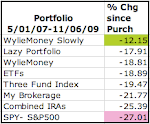
In the last 5 months, one fund I own is up over 70%.

It is still down over 12% since I purchased it, but at this rate, it might not be for long. While solid gains are good, it is possible most of the losses I see in my brokerage right now won't be around much longer.

So if I want to ensure that I have loses to offset my tax burden this year, I need to sell some funds. Of course, the markets could tank again, but I will not be any more or less invested after doing this so my risk will remain the same. If markets tank, I'll be able to sell the new funds at a loss down the road and off set more taxes.

I like the categories I am invested in, so I will only sell a fund when it is at a loss and I can find a fund in the same category, that I like as much or more.

It must have equal or lower fees and fund turnover, must have solid long term performance relative to its peers, and must be a no load, no fee fund available through Etrade.

I'll go through one fund at a time and see what I can find in the next few days.


12.28.2008

Making Lemonade Out of Lemons: Profiting from Mutual Fund Losses

If you a bought mutual fund in the last few years, chances are good, you're looking at a loss in that fund. If you've sold some equities for a profit, earned income this year or your fund paid a capital gains distribution or dividend, chances are good you owe taxes.

Did you know you can lower your taxes by selling your fund at a loss, if you hold it in a taxable account (not a 401k or 403b or IRA account)?

You might say "But wait a minute, Wylie! Buying high and selling low is a terrible investing strategy. If I sell my fund and the markets rally tomorrow, my calm will be seriously damaged."

"Whooooaaaaaa nelly..." is how I would respond. I don't think you should get out of the market while the markets are down.

What I am going to do (and what you may want to consider doing, if it makes sense given your situation) is look at the funds I own and sell a fund at a loss when I can find an equal or better fund in the same category that I can buy on the same day I sell. That way I remain 100% invested. I'll actually buy more in some categories and less in others to re-balance a bit, but you get the idea.

You might ask, 'what's the catch?'

There are several things to be aware of! The biggest catch is the Wash Sale rule. You can read a good detailed explanation of this here. Basically if you sell one security (for our purposes, this includes mutual funds, ETFs, or ETNs) and buy a "substantially identical" security within a certain number of days, you can't take the tax loss.

My understanding of this rule is that if you sell an index fund and replace it with a different fund that tracks the same index, you are likely to run into this. But if you sell a managed fund and replace it with an index fund, or vice versa, the investment strategies are fundamentally different. Even selling one managed fund and replacing it with another should be fine (but I'm not an accountant so do your own homework), assuming the managers dont use the same analysts/strategy, etc.

One risk is that the new fund you buy may not do as well as the old fund, but since we can't predict fund performance, I find this risk negligible. It is just as likely the new fund will do better, but that is not the reason to make the change. Expenses, turnover, and proven success from the manager and fund company are the best criteria for finding a solid fund to add to a taxable account, so if there are other good options out there, and you are sitting on a fund with a solid loss, why not take the loss and buy the new fund so that you remain invested in the category you want represented in your portfolio?

Other issues to consider...

Issue:
When you sell a mutual fund, the money from that transaction won't be available for several days so you need additional cash to buy a different fund on the same day. If I sell $2000 from Fund X and want to put $2000 into Fund Y, I'll need $2000 in cash in addition to the $2000 in fund X ($4000 total) in my brokerage account to buy and sell on the same day.

Solution:
If you have an emergency fund, you can use it to pull this off. Once all the cash from your sell orders are posted, you can put that back in your emergency fund. The downside is that you won't have that cash for a few days and if the market tanks after you place your sell order, you may end up with less $ than you planned.

Issue:
Your basis on the new purchase will be calculated on the day you buy. So if the markets rally back to where they were when you bought in and you sell, you'll owe taxes. You would not owe taxes if you simply hold on and the market rebounds and you sell at the same level you originally bought in at.

Solution:
There is none. If you make a profit in a taxable account, you owe taxes. Quit complaining and pay your patriotic share!

Keep in mind that it could take a while for markets to recover and that the tax rate on capital gains can't go much lower but it can go higher. So saving money now, means more money in your hands now to invest. If you save money on taxes and invest it, you'll have a bigger stake in the market which is a good thing if it does rally. Sure you'll owe taxes later (unless you come up with some other plan like this one) but you'll owe it on bigger profits than you would otherwise make and making bigger profits is kinda the point of investing.

Issue:
If I just bought a fund or invested in one, many funds charge a fee for selling right away and some brokerages, like Etrade which I use, charge their own fee, for selling no load, no fee funds (they charge a fee on no fee funds- hahahaha) if you sell in 3 months.

Solution:
Do your research. If you are going to be socked with fees, even thought you already lost a lot of value on a fund you just purchased, this plan may not make sense. You may want to wait until the required amount of time passes, to avoid any fees. So you don't get the tax write-off this year, you planning to not earn any income next year? You think the markets will rally 40% in the next 3 months?

Issue:
You have many many thousands of dollars in losses and no gains. How much will this really help?

Solution:
Talk to you accountant. You can write off up to $3000.00 against your income each year and losses carry forward so if you have gains or income next year, it is my understanding the loss you did not apply against your gains this year will apply nxt year and so on until you run out. But the longer it takes to reap the benefit, the more other issues come into play. If the market rallies next year, the unused tax savings may not be worth the new tax obligation you're now holding. Of course this depends on how long you plan to hold the funds...

Issue:
The fund you bought had a $2500 minimum initial purchase amount. You've lost $1000 in that fund. The better fund you found also has a $2500 initial minimum purchase amount, but you only have $1500 invested in this fund category. You'd have to add another $1000 to this category to buy the new fund.

Solution(s):
Add another $1000, pick a fund with a lower initial minimum or don't sell.

Summary:
If you have capital gains from this year- many funds that are down for the year still paid out capital gains distributions in the last few weeks and you WILL owe taxes on those distributions regardless of whether you sell or not- or earned some income, then this is worth considering. You'll need extra cash and you'll need to find equal or better funds to buy.

I can't help you with the extra cash, but I will share which funds I'm selling and which funds I'm replacing them with... I hope it helps!

11.08.2008

Portfolio Update 11/07/08: Bob the Drummer

At the end of this week, there is hope.

Hope for Bob the Drummer.

You see Bob the Drummer does not want his taxes to go up so he can buy a business. His story was so powerful that it launched a tour.

The tour was confusing, because it tried to make the point that Bob, who was worried about paying higher taxes, should support a candidate that would have him paying three times more taxes than if he supported the other candidate.

The average drummer in Bob's home state earns $47,930 a year.

Well those earning $47,930 would see their tax bill decline by $319 under the plan of the candidate who launched a tour touting Bob's struggles. But the other candidate's plan would see the average drummer's taxes decline $1042.

Bob did not quite understand this or did not care. Bob actually has no plans to buy a business, so the foundation of his story is a bit of a lie. Also turns out Bob is not a licensed drummer and does not bother to pay the taxes he owes under the current tax plan.

The reason there is hope today for Bob is that the candidate that plans to lower the taxes that Bob can continue to not pay by three times as much as the candidate that used Bob to try and scare a lot of people, is now the president elect.

So there is hope for Bob and anyone else who wants to be a drummer.


For those of us seeking to make pretend money with hypothetical investments, this week was a bit rough.

The WylieMoney portfolio of Mostly Managed mutual funds continues to be the best performing portfolio invested on May 1 2007, but by less than 1%.


WylieMoney 20 Mostly Managed
ETF 20
Three Fund Index
WylieMoney Slowly
Lazy 20 Mostly Index
S&P 500

10.21.2008

What I'm Doing as an Investor During the Financial Crisis

As the economy has turned south, I've been asked if I think it is a good time to cut back on retirement plan contributions. A friend recently moved all his retirement account investments into bonds. Investors pulled out of mutual funds in September in greater numbers than in any time in the history of the mutual fund industry. What is an investor to do?

I have a long time horizon until retirement, and I can leave my taxable investments in the market for a while. So I am following Warren Buffet's lead and am buying.

I'm doing four things.

1) I'm re-balancing my retirement account to be 100% Equities and increasing my small cap growth and large cap value investments.


I was already 90% invested in equities so this is not a huge change. I moved out of bond funds, which have certainly cushioned the decline in my retirement account. And I'm moving funds from an S&P 500 index fund into Dodge and Cox, a Large Cap Value managed fund. I have many years to go before I retire so even if markets decline further, I think being 100% in equities after 30-40% declines year to date, is a good plan for the long term.

2) I'm increasing my contribution to my employer based retirement plan (see above) from 13% of my salary to 16%. This is also not a huge change, but the more money I can invest while the markets are down significantly, the better.

3) I'm going through my taxable account, and looking for funds that I can sell at a significant loss. I will immediately reinvest in another fund in the same category, as I feel good about the asset allocation in my taxable account. But by selling at a loss and reinvesting, I maintain the same exposure to equities, I have a chance to replace funds that are not performing in line with peers in their categories, and I get to offset the loss against my income come tax day! I'll write a post with details about this soon.

4) I'm looking for cash to invest. Since I'm increasing my retirement contributions, my pay check will decline slightly. I have an emergency fund and though I already live comfortably below my means, there are ways I can cut back and save even more. So I'm looking to see if I can find cash to invest without depleting my emergency fund. More about this soon as well!

9.22.2008

Fund of the Week: DVY iShares Dow Jones Select Dividend Index

iShares Dow Jones Select Dividend Index posted a one week gain of 9.10%. Since hundreds of billions of our tax dollars are going to bail out many of the companies held by this fund, it stands to reason that investors want a piece of the action. Investors' tax burden has shrunk profoundly with Capital gains tax changes over recent years, taking tax money paid by everyone and redistributing it to investors through bailouts is just gravy.

Small caps and real estate also posted solid gains. Real Estate has seen a slow but steady rise as our tax dollars have also gone toward bailing out home owners who bought more house than they could afford. Not sure why small caps are up.


The big losers this week were emerging and foreign markets and bonds. Vanguard Emerging Markets Stock ETF VWO lost 8.08%. I guess investors feel that countries that do not have the will or the means to bail out companies that do stupid things aren't as tempting these days.


It is worth noting that VWO lost 8.08% while the Emerging Market fund I picked SSEMX (and actually own) only lost 0.35%. It is odd, that the Vanguard Mutual Fund only lost 0.77%.

The big emerging markets news last week was the collapse of the Russia's Mafia, I mean Market.

Maybe the Vanguard ETF office did not get the memo that the Vanguard mutual fund office got about selling Russian positions as commodities fell over the last few weeks...

4.15.2008

Happy Tax Day!

Today is the last day to send the government your money so they can turn around and give me my apology check!

If you have not filed yet, don't forget, if you use Turbotax, you can get a discount by clicking here. I railed before about how absurd it was for Turbotax to charge for its free version so it could then provide a 'discount.'

A WylieMoney reader noted that the Free Edition is not the same as the Basic Edition. This appears true despite the fact that both editions describe themselves as for "Simple" returns and are listed in the same ad format as the far left option which is deceptive and misleading.

Regardless, the Discount page does not even note that a free option is available which is poor form so if you have a very simple return and have not filed yet, go find the free version!

Also note that if you plan to waste money on (I mean treat yourself to) a coffee at Duncan Donuts today, you can get a donut for free (Thanks for the tip Marian and Sheryl!).


If someone tries to offer you a discounted donut, well, don't be suprised, but don't pay...

3.02.2008

Etrade and Taxes

Last year, Etrade had alerts all over its interface and sent me notices that I may receive updated tax info, after I received my original 1099 form. I was grateful since I knew to wait to file my taxes or risk needing to refile.

This year, there were no alerts and no messages.

I assumed Etrade had updated its business processes from last year to catch up with changing regulations and was prepared to get accurate tax information to me on time.

I even read blog posts that other brokerages were warning their customers that they may get amended 1099 statements. I was pleased that Etrade was more on the ball than these other brokerages.

Boy was I wrong.

Etrade backtracked big time. On Saturday, March 1st , I got an amended 1099. I got an amended tax form in March.

As I wrote before, I don't mind that with ridiculously complicated regulations, amended forms are necessary. I'm disappointed in my government that we have overly complicated regulations in how real estate investments are taxed, but vastly inadequate regulations in how those investments are made.

Anyway- Etrade could have put the same message up that it did last year but they did not. They could have emailed me as a customer with real estate investments and foriegn investments that I may receive an amended tax form but they did not.

The good news is that I have not filed my taxes yet and I was able to sign into my turbotax account and re-download my statement from Etrade and see the information and all the impacts automatically updated. What I owe in state taxes went up almost 100%. Fortunately the increase in my federal refund went up more than enough to cover the difference.

Shame on you Etrade for not communicating what you communicated last year. You even included a document with the amended statement with a form dated 1/08 called "Enclosed is your amended Consolidated Form 1099." If you knew in 1/08 that you needed a form for your customers, why not let us know?

Shame on me for assuming Etrade was on the ball.

Kudos to me (maybe my unconscious) for waiting to file my taxes even though I had already done them.

2.25.2008

Turbotax Discount 25% Off Available for Anyone

Looking around for discounts off TurboTax, I found one offered by Fidelity. The nice thing is you do not have to be a Fidelity customer to take advantage!

If you are interested, click here.

And then choose the "Visitor Entry" link.

There may be better deals out there but this is the best I found so far.


But- if you file a 1040EZ- be CAREFUL!!!! You can use TurboTax for free at this link.

If you go direct to TurboTax the 1040EZ is free:


But if you want the 25% discount, the 1040EZ costs $14.95:


I understand that 25% off free is difficult to calculate, but come on. Charging $15 to give a discount off something that you give away for free????

That's just wrong.

2.17.2008

I Can't Wait for my Apology Check!

I find it ironic that a Republican administration's response to too little regulation/oversite over loan company lending practices is to take tax money, overwhelmingly paid by high income earners, as they like to remind me, and give some of that money to me.

I think of it as less of a stimulus and more of an "Oops sorry. This should make you feel better."

It may very well be that reduced regulation and high enough tax revenue (thus the irony at the Republicans doing this) to send out the occasional 'apology check' when unregulated business schemes collapse IS the most efficient way for the economy to chug along...

But does that make it the best choice for a Democratic/free market society?

Actually the apology checks are the least interesting regulation getting rushed through the door these days. (Interesting pattern of 'spin a situation as a crisis so government has to rush changes into law.')

Businesses are getting nice perks out of this. Businesses that have nothing to do with sub-prime lending (no WMDs) or are in no way associated with mortgage debt (did not associate with Osama) need these changes passed NOW as a response to this economic CRISIS.

And wealthy home owners will be able to refinance large mortgages at lower rates, generally saving far more than $600. Actually, I wonder how much top tax payers will be able to save after refinancing their loans and how that compares to how much tax they had to pay to give the rest of us apology checks...

Those losing their jobs as a result of the recent turmoil and those struggling with payments for things like heating oil, will have to be content with their $600.

"Republicans yesterday blocked consideration of the stimulus measure approved by the Senate Finance Committee because they opposed Democrats' plans to add extended unemployment benefits, home heating assistance and alternative energy tax credits to the measure passed by the House."

Anyway, I assume that a scientific assessment of the loan changes and business perks proved that they would offer far more financial stimulus than extended unemployment benefits and home heating assistance and that is why that decision was made... so much research and assessment has gone into the other hasty government action taken in similar 'spin crisis, act now' campaigns and that have worked out well (WMDs, war planning, post war planning, etc.) so I feel good about things this time too.

1.08.2008

Reinvesting dividends and capital gains in a taxable account

Up until now, I had all my mutual fund dividends and capital gains distributions set to automatically reinvest in my taxable brokerage account.

This creates a bit of work when it comes to calculating the basis on my holdings when I sell a fund, but I don't mind. And with online brokerages, it is not much work at all. Etrade keeps track of the basis and I assume other brokerages do too. So as long as I note the basis before I sell and the holding no longer shows in my portfolio, and the records are accurate for holdings I bought before I started using Etrade, there is no work to do at all.

There are four reasons I turned off automatic dividend reinvesting, anyway:

1) If you sell a no-load no-fee fund within 90 days of purchase you are penalized a fee of $49.99. I do not know that this applies to automatic reinvestments (I assume it does), but I'd rather not worry or risk the hassle.

2) If I think I want to sell a fund, I typically don't add anything to it for a year before I sell so any gains are taxed as long term gains. I have two funds I have not been adding to since last June, thinking I might sell after my last addition to the funds is a year ago or greater. In December the funds distributed and reinvested automatically. This complicates the tax implications of a sale unless I now wait until next December which has slightly agitated my calm.

3) I invest regularly adding small amounts to some holdings to keep my overall portfolio balanced as I want it. Taking gains and distributions as cash and manually adding them to the funds I want to gives me more control over keeping my overall portfolio in balance. For some people (those who would let the cash sit) this might not be a good idea, but I have seen that I regularly take the cash I save in my brokerage and invest it, so this should work well for me.

4) Even though Etrade keeps good records of all my purchases, when Etrade bought my previous brokerage, the old electronic details did not convert over. I assume if Etrade goes under or another firm buys Etrade, or I end up with a new brokerage for any reason, the balances will transfer but the details about my basis will not. Sure I can keep track of everything myself, but to do so is more hassle than it is worth.

If you have an Etrade account that is not a retirement account, or even if it is a retirement account, and you want to un-enroll from automatic reinvesting, simply go to the online service center and type in a request to customer service for them to make the change. For mutual funds, you cannot do it yourself through their interface.

I left my Roth IRA alone so it still automatically reinvests. Since I only add to the IRA once a year, and I cannot add enough to rebalance all the holdings by adding to the market sectors that trailed the year before, and I don't have enough in the IRA for the dividends and distributions to be significant, and the IRA is not taxed like a non-retirement account, it make sense to me to allow the dividends to reinvest.

On an unrelated note, check out the Coyote I saw romping around in the snow in my driveway the other day!

1.02.2008

Next pick for WylieMoney Slowly is Real Estate!

That's right, Real Estate!

If you want to invest in what's hot, like I said before, buy some corn:


For the WylieMoney Slowly portfolio, I am adding one fund per month in the order I originally researched each of the 20 categories I picked. This month is Real Estate. Plus, buying low is half the battle, right?

A quick glance at Etrade for no-load, inexpensive Real Estate funds confirms that SSgA T. Act. REIT - SSREX is still the best fund available (My Post).

Just to reiterate, I am not advising anyone go out and buy a Real Estate fund for a taxable (non-retirement) account. I am tracking the performance of hypothetical accounts and trying to learn a thing or two about mutual fund investing strategies along the way. I do actually own a Real Estate fund in a taxable account and I can confirm that it is taxed higher than standard mutual funds and getting accurate tax information about it holds up my taxes every year so it is a headache and a half.

Regardless, today is the day I'll add the Real Estate fund.

12.11.2007

Today is the day I'm adding SLASX: Selected American Shares

Today is the day I'm adding SLASX to the WylieMoney Slowly hypothetical portfolio. I'm not
actually adding money to any real funds since I have not had time to research which ones have and have not paid capital gains distributions.

Why buy a fund today (placing the order before 4pm!)? Read here.

11.25.2007

What is this thing called "Mutual Fund Turnover?"

oneopinion left a comment and asks: "...why is high turnover a negative in a mutual fund and why do you set a turnover rate of 100% as the maximum?"

Thanks for the question. First, let me clarify, I did not set 100% as a maximum, and I do not have a maximum for new picks for my hypothetical portfolios. I do, however, prefer low turnover so lower expenses or much better long term performance would be necessary for me to choose a fund with high turnover over a comparable choice.

The question was why?

The hypothetical portfolios I have been tracking are for a non-retirement account so any capital gains would result in hypothetical taxes owed and higher turnover is more likely to lead to more capital gains

Morningstar.com defines turnover ratio:

"This is a measure of the fund's trading activity, which is computed by taking the lesser of purchases or sales (excluding all securities with maturities of less than one year) and dividing by average monthly net assets. A turnover ratio of 100% or more does not necessarily suggest that all securities in the portfolio have been traded. In practical terms, the resulting percentage loosely represents the percentage of the portfolio's holdings that have changed over the past year. A low turnover figure (20% to 30%) would indicate a buy-and-hold strategy. High turnover (more than 100%) would indicate an investment strategy involving considerable buying and selling of securities. Morningstar does not calculate turnover ratios. The figure is culled directly from the financial highlights of the fund's annual report."

The Motley Fool sums it up thusly:

"Turnover Rate and Taxes. A fund's turnover rate basically represents the percentage of a fund's holdings that it changes every year. A managed mutual fund has an average turnover rate of approximately 85%, meaning that funds are selling most of their holdings every year. Because buying and selling stocks costs money through commissions and spreads, a high turnover indicates higher costs (and lower shareholder returns) for the fund. Also, funds that have large turnover ratios will end up distributing yearly capital gains to their shareholders. Shareholders will have to pay taxes on these gains, and paying these taxes can be a real killer. Keep an eye on the turnover rate of any fund you own, and look to own funds with low (preferably no higher than 25%) turnover rates. (Index fund turnover is around 5% or lower.)"

Emphasis added.

I have no idea why fool.com claims that index fund turnover is 5% or lower. In my portfolios of index funds and ETFs almost all the funds have turnover much higher than 5%.

Take VIGRX Vanguard growth index. It has a turnover ratio of 28%. Not bad, but nowhere close to 5%.

3.24.2007

What investment records should you keep?

Keep them all.

Lots of financial sites and blogs post articles offering advice about what records to keep in general: bankrate, soundmoneytips, realsimple, even the IRS has made an attempt.

As is often the case, Morningstar has one of the best explanations for why this matters when it comes to investment records.

I keep every monthly statement from my brokerage and have a file over 2 1/2 inches deep to show for it. I wish this was an indicator of massive wealth, but really it is just a symptom of reinvested dividends.


If you put $500 in a growth and income fund and reinvest the dividends and capital gains, each payment- in cents, dollars, whatever, is a transaction on the statement. And at the end of the year, you pay income taxes on those payments, even though they are (re)invested, and not cash in your pocketses. So if you do not have a ton of money (yet!), but still want to diversify broadly and put a small amount of money in a number of funds instead of just piling it all into one, your statements get long.

Some of the new retirement funds like Vanguard Target Retirement 2050 are actually a collection of funds, so you can put all or some of your money in one of these, even if you do not plan to save it until retirement, and diversify that way, but I digress

Some brokerages are no longer sending paper statements automatically and actually charging investors for this 'privilege.' Here is Ameritrade, disclosing its fees:

So if you only get electronic statements, or opt to get electronic only, you have to keep those too. And back them up!

I finally got my 3rd and 4th brokerage account tax statements. One of these adjustments changed how $22.46 was allocated for tax purposes. I waited a month and a half to file my taxes because of how $22... good grief.

So anyway, I sold a fund last year and I knew how much I originally invested, and Etrade does a good job of keeping track of funds that have automatically reinvested since they bought my account from my previous brokerage. My old records, however, did not convert to my Etrade account so I had to go back through my paper records starting in 2000 when I bought the fund to calculate my actual basis. This took me about 3 minutes to do because I had all my records in order and this changed my basis by a couple of hundred dollars which lowered my tax bill enough to buy a decent bottle of wine! Or, if I shop at Trader Joe's, 3 or 4 decent bottles of wine!

So the lesson here is that you should keep your statements, paper or electronic, because your brokerage may be bought by a competing brokerage, or it may raise its fees and you may transfer your account to a better brokerage and all your details may not transfer over. And unless you want to pay the tax man (or woman) for the same profits twice, you'll want to be able to add up your actual basis, not just the amount you originally invested and having your statements handy and organized makes this pretty easy.

3.05.2007

Government passes law to steal from citizens

So like I predicted, I got four tax statements from my brokerage account.

What a pain.

I received two statements because my old brokerage was swallowed up by my new brokerage and I got two more statements supposedly because recent changes in tax law have made it so difficult for companies to figure out how to report their profits that it takes over two months just to do the math.

That's right- I got home from work- after spending my day doing my part to keep the GDP strong while markets around the globe writhe in agony- to find two updated tax statements.

Thankfully, Etrade had alerts on its site indicating that this would happen so I avoided filing taxes only to have to refile.

And yes- the title of this post is a bit of a stretch, but here is my thinking:

The government has passed regulations so complicated that it now takes much longer to run the numbers so many investors find it more difficult to file taxes until much later meaning...

The government gets to keep my tax withholdings for longer. Since I am not being paid interest on this, this money can be put to use, grown, used as green wallpaper, whatever.

So rather than raise taxes- politicians should just continue to make regulations more and more difficult so that the government can hold tax payments for longer periods, collecting the interest on my money.

Wait a minute you say- Wylie does not usually rant and rave and spin conspiracy theories... Well I just picked a bond fund which is pretty boring, so I'm trying to be more... lively.

Plus, even the folks in Hawaii are agitated about this one.

1.26.2007

Wait to file your taxes if...

...you own a brokerage account.

I was jealous of a colleague who declared that he already had his tax refund on the way. I was even more jealous of the fact that his refund was small.

Why would I be jealous of a small refund?

In this case the government has been taking only as much money from my colleague over the course of the year as he ultimately would owe in taxes. Some people like getting big refunds, but that is a big interest free loan you are giving to the government... If you have enough income to do that, I've got a bridge for sale...

So if you can only have what you will owe withheld (takes good planning), you get paid more throughout the year meaning you have more every two weeks to donate to charity, spend on bird seed, or spend at the movies.

Anyway- last year I got an amended tax statement from my brokerage and I was really glad I had not submitted my taxes, because I would have had to re-submit them with the new form if I had been more on the ball. This year, I have yet to receive my tax statement from etrade and when my colleague was like "I'm done with my taxes" I was all like- "what is up with my stuff?"

So I logged into my etrade account and found this buried in the page that allows you to view your tax forms:

"If you hold a mutual fund, REIT, or RIC, we may need to issue you an amended Form 1099. This may affect the date you will want to file your tax return. To minimize the possibility of multiple corrections, we will not be generating amended 1099s until late February 2007."

I didn't even know what a RIC was but I own Mutual Funds and a REIT (Boston Properties).

My initial reaction was- why can't etrade get this stuff right the first time? Then I read an article by Andrea Coombes that led me to believe that brokerages are required (perhaps by law?) to send tax info by Jan 31st, but that many mutual funds and REITS send updated info to brokerages after this date forcing brokerages to send multiple copies and forcing those of us who invest in Funds and REITs to wait to file our taxes or file multiple times. Andrea specifically notes that some Brokerages are seeking permission to wait to send their tax info to clients.

Since etrade bought my old brokerage, but the transfer did not happen until a couple of weeks into Jan. I wonder how may tax forms I will actually get...

etrade does have this message on my account home page:

"1099s Available by January 31st.
This year as part of your move to E*TRADE Financial, you may receive TWO tax statements for 2006. Your tax statement(s) will be mailed to you and made available online by January 31."

What this should say is that I may receive FOUR tax statements and should not even bother trying to figure out my taxes until the end of Feb.

But regardless, the confusion and how long it is taking for me to receive this info does not appear to be etrade's fault, but rather a result of changing and complicated regulations.

1.25.2007

Tax day moved for everybody- not April 15th...

Taxes this year are due April 17th for everyone. Not the 15th, which is a Sunday. Not the 16th, even though your forms will most likely claim this. But Tuesday, the 17th.

Why? you might ask. I mentioned that us Massachusetts residents get until the 17th because of the timing of Patriot's Day. Of course the rest of the country is not patriotic and/or does not celebrate our football team (even in shameful defeat) with a day off, but our esteemed representatives in the District of Columbia are taking the day off to celebrate Emancipation Day so the entire country gets an extra day to pony up our taxes. Don't just take my word for it (ever)- check it out yourself.

I will post soon about why every extra day helps, even if you are getting a refund...

1.09.2007

Where are the charts?

A friend and faithful Wylie Money reader asked me- "Where are your charts? Your Graphs? The track record of your hypothetical portfolio as it takes the S&P 500 and thrashes it soundly, beating it into the ground?"

I started on a long post about how there is no free portfolio tracking tool that automatically re-invests dividends and capital gains pay-outs especially from a historical date and I have not found a good tool to allow me to do this manually for the 20 funds I plan to track...

Then I started thinking about my friend and his question and I got bitter and decided that he just wanted charts because his brain has frozen solid and gone numb because of all the snow he has suffered through recently (he lives in Denver).

Then I realized, yea... I need some charts. But it could be a bit tedious to manage so here is my plan:

I will chart the investment of $2500 per fund in each fund with $100 additional contributions on specific days I will pick each month (more about this process later). I am starting with a minimum of $2500 because several of the funds I have picked so far require this much and none of the funds I have picked (or will pick) require more than this- so one could actually follow this plan. Same reasoning behind the subsequent $100 additions.

I will do this one of 2 ways. I will pick about 20 funds total and either:

a) One of you can give me $50,000 and $2000 per month- which is the cost of investing in this entire portfolio and I will invest it and etrade can re-invest the distributions and capital gains!!!!!

or

b) I will set up a hypothetical portfolio- in Morningstar but please post a comment if you know of an easier to use free portfolio tool. And I will try and keep track of reinvesting dividends, etc. manually which will be tedious and make me sad.

or

c) I will just set up a portfolio to track daily NAV (prices) which will give a general sense of earnings and be less tedious.

Final note- until I pick all 20 funds, I will not set this up because going back and trying to get historical info and tracking the funds and picking new ones all at once would require more time spent on this that I am willing to commit.