...but they still have not contacted me to let me know.
Basically, the minimum investment amounts for some mutual funds was not correct in their online interface.
More importantly, no one has explained to me what happened and why it happened. So I have no way of knowing if it is likely to happen again.
Perhaps they are too busy ending the program that reimbursed 12b-1 mutual fund fees.
Or maybe they are distracted by all the talk with Ameritrade about the possible "same-sector" marriage they are contemplating.
Regardless, I reported the issue in mid July and then again on August 7th. It was fixed around August 10th. But I have not heard it was or if I should expect that it will remain fixed. So I'll have to hope that next time I want to add to one of the funds I invested in, I will be able to...

8.26.2007
Weekly Update: WylieMoney Ties For First
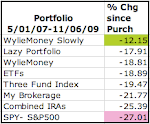
Wyliemoney takes the lead by $2. But we'll call it a tie with the 3 Fund Index.

The corresponding Mostly Index Portfolio is in the red since May, but the WylieMoney mostly managed portfolio has turned a very small profit as has the 3 Index Fund portfolio. All told, the spread is pretty small.


The corresponding Mostly Index Portfolio is in the red since May, but the WylieMoney mostly managed portfolio has turned a very small profit as has the 3 Index Fund portfolio. All told, the spread is pretty small.


8.20.2007
How Many Mutual Funds is Too Many?
Some folks over on Morningstar's discussion board tossed around the question:
"How Many Mutual Funds is Too Many?"
My answer is, "It depends."
“On what?” you might ask.
Well, a number of things.
Let's explore!
I have almost 60 funds. I can safely say, that is a ridiculous amount, but I don't mind. That brings me to point one.
1) If you don't mind how many you have, you don't have too many.
If you can't keep track of the funds, or feel overwhelmed when trying to manage your investments, you have too many. My tolerance for spending time keeping track of my funds is very likely higher than average, as evidenced by the fact that I write a blog about it. I do not recommend, doing what I do, to anyone else.
I find tools like Yodlee and Morningstar's free portfolio tool as well as the interface in each of the accounts I hold the funds in, makes it pretty manageable, for me. This brings me to my next point.
2) You need enough to achieve your goals for the money in each investment account.
My wife and I both work and we both have employer sponsored retirement plans and IRAs and we share a brokerage account. Our situation is not a-typical and that adds up to 5 accounts. Not all five are with the same brokerage and that means that funds available in some accounts are not available in others. Since the retirement accounts will remain invested until we retire and we are many years away from that, the funds best suited for very long term growth are not always the same as what we choose in our non-retirement account as we hope to use funds in that account before retirement (which is the reason we have it). Furthermore, we likely won’t tap the Roth IRAs at the same time as the 403(b)s depending on our tax situation at the time. Given all that, I choose to balance (Stock vs bond, Large Cap vs Small Cap, Domestic vs International, etc.) each of the five accounts as independent accounts. That way, as we access them at different times, I won’t have to re-balance one account because I drew down on another.
3) You need enough to attain diversity in fund companies.
I like to pick funds from different fund companies (Janus, Bridgeway, Artisan, T. Rowe Price, etc.) on top of picking funds that cover different categories (Large Cap Growth, Intermediate Term Bonds, Real Estate, Small Cap Foreign, etc.) A fund company might cover different categories, but they have one corporate culture and a pool of analysts who all work in the same environment, so there can be serious overlap in the companies that their analysts are recommending to their fund managers. Also, no one fund company has all the best managers in every category. When I picked the 20 funds for my hypothetical portfolio through Etrade, I ended up with a wide mix of fund companies without really trying.
4) You may end up with more than you need, depending on your employment history.
My employer used to allow me to use Janus for my 403(b) contributions so I had a portfolio of Janus funds. Then we switched to a company that picks top funds in each category regardless of fund company. I gladly signed up with the new, more diverse program, but I left my investments at Janus instead of rolling them over. Janus is strongly growth oriented overall and I liked having an investment at a pretty young age in a more aggressive portfolio than the new plan offers. This means I have 2 403(b)s with 8 funds at Janus and 12 in the other account. Our IRAs are held at Etrade and I cannot buy most of the funds available to me through my non-Janus 403(b) even if I wanted too. I do not want to add more in Janus funds for retirement so I am left looking for alternatives. Typically each year as I contribute to my IRA, I look for categories that I am not invested in that have been lagging, and then pick a good fund or ETF with a low minimum purchase amount (for funds) so I can diversify as much as possible. Having done this for several years and finding options that let you invest relatively small amounts, I have 14 funds in my IRA.
5) You need enough to diversify across sectors and/or categories.
You’ve heard the advice: “Invest in stocks and bonds.” And certainly you can buy a couple of index funds that broadly cover the stock and bond markets. Throw in a broad international index fund for good measure and you are pretty darn diversified with very little effort or upkeep. That approach may well be ‘enough’ to diversify across sectors. But if you want to invest systemically and try and follow a strategy of investing in categories that are down, presumably in the short term, you will need to pinpoint more specific categories or sectors. Real estate, small cap value, financial services, and precious metals have all struggled lately. To invest in these specifically you need to own funds that have these categories as their focus. How detailed you want to get will depend on your tolerance, your interest and your goals. The more detailed you get the more funds you probably need. For example, you probably would not want a portfolio of just the four sectors above unless you like to gamble.
6) You may not need any, if you have enough time and money to diversify in individual companies.
Mutual funds aren't for everyone. If I had enough money to invest in enough individual companies to feel adequately diverse (I kinda obsess over diversity so it would take a lot) and I had the time and expertise to stay on top of each company's performance and prospects, I might forgo funds and choose another path. Afterall, why pay fund managers year after year to do what you can do yourself!
7) If your time horizon is short, one may be too many.
If your time horizon is short, mutual funds or ETFs are probably not the best place for your savings. Note that portfolios of 20 funds spread across 20 sectors, 20 ETFs invested likewise and even the simple three index fund approach all lost money since May... with the 20 ETF portfolio down over 4%! Of course if you choose a money market fund, that might do well...
In summary, don’t invest in more funds than you can manage, but don’t avoid investing in a fund that interests you, if investing in it would help you meet your goals.
Recap- things to consider when trying to decide how many mutual funds is enough:
"How Many Mutual Funds is Too Many?"
My answer is, "It depends."
“On what?” you might ask.
Well, a number of things.
Let's explore!
I have almost 60 funds. I can safely say, that is a ridiculous amount, but I don't mind. That brings me to point one.
1) If you don't mind how many you have, you don't have too many.
If you can't keep track of the funds, or feel overwhelmed when trying to manage your investments, you have too many. My tolerance for spending time keeping track of my funds is very likely higher than average, as evidenced by the fact that I write a blog about it. I do not recommend, doing what I do, to anyone else.
I find tools like Yodlee and Morningstar's free portfolio tool as well as the interface in each of the accounts I hold the funds in, makes it pretty manageable, for me. This brings me to my next point.
2) You need enough to achieve your goals for the money in each investment account.
My wife and I both work and we both have employer sponsored retirement plans and IRAs and we share a brokerage account. Our situation is not a-typical and that adds up to 5 accounts. Not all five are with the same brokerage and that means that funds available in some accounts are not available in others. Since the retirement accounts will remain invested until we retire and we are many years away from that, the funds best suited for very long term growth are not always the same as what we choose in our non-retirement account as we hope to use funds in that account before retirement (which is the reason we have it). Furthermore, we likely won’t tap the Roth IRAs at the same time as the 403(b)s depending on our tax situation at the time. Given all that, I choose to balance (Stock vs bond, Large Cap vs Small Cap, Domestic vs International, etc.) each of the five accounts as independent accounts. That way, as we access them at different times, I won’t have to re-balance one account because I drew down on another.
3) You need enough to attain diversity in fund companies.
I like to pick funds from different fund companies (Janus, Bridgeway, Artisan, T. Rowe Price, etc.) on top of picking funds that cover different categories (Large Cap Growth, Intermediate Term Bonds, Real Estate, Small Cap Foreign, etc.) A fund company might cover different categories, but they have one corporate culture and a pool of analysts who all work in the same environment, so there can be serious overlap in the companies that their analysts are recommending to their fund managers. Also, no one fund company has all the best managers in every category. When I picked the 20 funds for my hypothetical portfolio through Etrade, I ended up with a wide mix of fund companies without really trying.
4) You may end up with more than you need, depending on your employment history.
My employer used to allow me to use Janus for my 403(b) contributions so I had a portfolio of Janus funds. Then we switched to a company that picks top funds in each category regardless of fund company. I gladly signed up with the new, more diverse program, but I left my investments at Janus instead of rolling them over. Janus is strongly growth oriented overall and I liked having an investment at a pretty young age in a more aggressive portfolio than the new plan offers. This means I have 2 403(b)s with 8 funds at Janus and 12 in the other account. Our IRAs are held at Etrade and I cannot buy most of the funds available to me through my non-Janus 403(b) even if I wanted too. I do not want to add more in Janus funds for retirement so I am left looking for alternatives. Typically each year as I contribute to my IRA, I look for categories that I am not invested in that have been lagging, and then pick a good fund or ETF with a low minimum purchase amount (for funds) so I can diversify as much as possible. Having done this for several years and finding options that let you invest relatively small amounts, I have 14 funds in my IRA.
5) You need enough to diversify across sectors and/or categories.
You’ve heard the advice: “Invest in stocks and bonds.” And certainly you can buy a couple of index funds that broadly cover the stock and bond markets. Throw in a broad international index fund for good measure and you are pretty darn diversified with very little effort or upkeep. That approach may well be ‘enough’ to diversify across sectors. But if you want to invest systemically and try and follow a strategy of investing in categories that are down, presumably in the short term, you will need to pinpoint more specific categories or sectors. Real estate, small cap value, financial services, and precious metals have all struggled lately. To invest in these specifically you need to own funds that have these categories as their focus. How detailed you want to get will depend on your tolerance, your interest and your goals. The more detailed you get the more funds you probably need. For example, you probably would not want a portfolio of just the four sectors above unless you like to gamble.
6) You may not need any, if you have enough time and money to diversify in individual companies.
Mutual funds aren't for everyone. If I had enough money to invest in enough individual companies to feel adequately diverse (I kinda obsess over diversity so it would take a lot) and I had the time and expertise to stay on top of each company's performance and prospects, I might forgo funds and choose another path. Afterall, why pay fund managers year after year to do what you can do yourself!
7) If your time horizon is short, one may be too many.
If your time horizon is short, mutual funds or ETFs are probably not the best place for your savings. Note that portfolios of 20 funds spread across 20 sectors, 20 ETFs invested likewise and even the simple three index fund approach all lost money since May... with the 20 ETF portfolio down over 4%! Of course if you choose a money market fund, that might do well...
In summary, don’t invest in more funds than you can manage, but don’t avoid investing in a fund that interests you, if investing in it would help you meet your goals.
Recap- things to consider when trying to decide how many mutual funds is enough:
- If you don't mind how many you have, you don't have too many.
- You need enough to achieve your goals for the money in each investment account.
- You need enough to attain diversity in fund companies.
- You may end up with more than you need, depending on your employment history.
- You need enough to diversify across sectors and/or categories.
- You may not need any, if you have enough time and money to invest in individual companies.
- If your time horizon is short, one may be too many.
8.18.2007
Weekly Portfolio Update: WylieMoney Loses Lead
Both the S&P 500 and the Three Fund Index portfolio pulled ahead of the WylieMoney 20 Mostly Managed.
 Despite all the craziness of the past week, my benchmark for the S&P 500, SPY, ended the week exactly where it began. Since all the other portfolios lost ground, SPY pulled ahead by going nowhere!


Some weeks the weekly update will come on Saturday. Last night I was suffering over at Fenway Park...

 Despite all the craziness of the past week, my benchmark for the S&P 500, SPY, ended the week exactly where it began. Since all the other portfolios lost ground, SPY pulled ahead by going nowhere!
SPY- S&P 500

Three Fund Index

WylieMoney 20 Mostly Managed

WylieMoney Mostly Managed One Fund per Month

Lazy 20 Mostly Index

ETF 20

Some weeks the weekly update will come on Saturday. Last night I was suffering over at Fenway Park...

8.17.2007
Poll: Is now a good time to invest?
If you haven't voted yet, take you pick! The poll is on the menu on the right.
Ben Stein's view gave me a chuckle...
Ben Stein's view gave me a chuckle...
...the stock market is cheap on a price-earnings basis, profits are fabulous, Mrs. Clinton and Mr. Giuliani are far from being socialists and in the long run, both here and abroad, stocks are a lovely place to be. I have no idea what the S&P will be ten days from now, but I am confident it will be a lot higher ten years from now, and for most Americans, that's what we need to think about. The subprime and private equity and hedge fund dogs may bark, but the stock market caravan moves on.Of course my poll does not include anything you would actually want to consider when investing. Things like:
- how long can you leave your investments alone?
- what is your risk tolerance?
- ummm, invest in what?
- etc
8.16.2007
I told you I loved this market!
At the end of my post yesterday, I said "I am loving this market these days." Today, on my lunch break, I invested a little more (real money, not hypothetical). By 4 pm everybody else jumped on the bandwagon and the market recovered from another huge loss to close basically flat. I had hoped it would stay down, but oh well.
Now, I'm no expert, but what I see is continued strong profits, largely due to increased productivity, which I attribute to companies finally making good use of faster computers and decent software. The economy is chugging along, overseas markets are doing great, emerging markets still have tons of room to grow as more jobs land there, building new generations of workers with money to spend, etc, etc.
A certain number of our neighbors lied to themselves and their mortgage brokers about how much house they could afford. Many of them signed up for adjustable rate mortgages that they were told would go up in a few years. A few years passed, and their loans went up- probably on the low end of what they were told, given that interest rates are still very low,- and now they can't pay. To them I say, deal with it.
I'm sure there was some fraud, and I understand much of the concern around how mortgages are sold to Wall Street so fast that brokers have no incentive to confirm that buyers aren't lying. This is not cool and something should be done.
I'm also sure there are some who stretched just a little and bad things happened- layoffs, sickness, life, etc. and now they can't afford their homes. To them I say, I'm sorry. I hope they can turn their finances around and get back on their feet.
The question investors have to ask is- how much of an impact will all this have on global markets?
My guess is, not as much as the recent sell-off would suggest, and that is why I invested. Also, my sense is that valuations on stocks are reasonable, overall. Morningstar calculates that the markets are undervalued:
 but you only have to look back to the early 2000's to see that things can get a whole lot worse...

But I think that the steep decline after 2000 was a reaction to ridiculous valuations and I do not believe that valuations are ridiculous or where earlier this year, so I see the recent quick sell-off as a good opportunity to invest. If only I had some extra cash!
Off course, I could be wrong.
Now, I'm no expert, but what I see is continued strong profits, largely due to increased productivity, which I attribute to companies finally making good use of faster computers and decent software. The economy is chugging along, overseas markets are doing great, emerging markets still have tons of room to grow as more jobs land there, building new generations of workers with money to spend, etc, etc.
A certain number of our neighbors lied to themselves and their mortgage brokers about how much house they could afford. Many of them signed up for adjustable rate mortgages that they were told would go up in a few years. A few years passed, and their loans went up- probably on the low end of what they were told, given that interest rates are still very low,- and now they can't pay. To them I say, deal with it.
I'm sure there was some fraud, and I understand much of the concern around how mortgages are sold to Wall Street so fast that brokers have no incentive to confirm that buyers aren't lying. This is not cool and something should be done.
I'm also sure there are some who stretched just a little and bad things happened- layoffs, sickness, life, etc. and now they can't afford their homes. To them I say, I'm sorry. I hope they can turn their finances around and get back on their feet.
The question investors have to ask is- how much of an impact will all this have on global markets?
My guess is, not as much as the recent sell-off would suggest, and that is why I invested. Also, my sense is that valuations on stocks are reasonable, overall. Morningstar calculates that the markets are undervalued:
 but you only have to look back to the early 2000's to see that things can get a whole lot worse...
But I think that the steep decline after 2000 was a reaction to ridiculous valuations and I do not believe that valuations are ridiculous or where earlier this year, so I see the recent quick sell-off as a good opportunity to invest. If only I had some extra cash!
Off course, I could be wrong.
8.14.2007
New Orleans Satellite Photo!
I wrote a note on Zillow's blog and got some feedback about the New Orleans pictures on their site. Here is my earlier post about what I was looking for.
They noted the company that provides their imagery so I went to their site and dug around a bit and found a more recent image:

Compare the image above with the older one I took from Google maps- all the houses on the big field in the middle are part of the Musicians' Village.

The houses we worked on are not visible on these images, but over time, they will show up.
So I will try and get a post up soon about why I am loving the market these days. The 2 second summary is that when the market goes down for reasons largely unrelated to the earnings of the vast majority of the individual companies that make up 'the markets' this screams -to me at least... buy!
So I did. And I bought into the fund I was unable to add to in small amounts through Etrade, because Etrade fixed my problem. Strangely enough, they have yet to let me know. I just stumbled across it, when I went to buy some funds.
Finally, a WylieMoney fan asked for specifics about 0% credit cards with no balance transfer fees. It just so happens, I need one myself so I will be doing some research on that as well.
More soon!
They noted the company that provides their imagery so I went to their site and dug around a bit and found a more recent image:

Compare the image above with the older one I took from Google maps- all the houses on the big field in the middle are part of the Musicians' Village.

The houses we worked on are not visible on these images, but over time, they will show up.
So I will try and get a post up soon about why I am loving the market these days. The 2 second summary is that when the market goes down for reasons largely unrelated to the earnings of the vast majority of the individual companies that make up 'the markets' this screams -to me at least... buy!
So I did. And I bought into the fund I was unable to add to in small amounts through Etrade, because Etrade fixed my problem. Strangely enough, they have yet to let me know. I just stumbled across it, when I went to buy some funds.
Finally, a WylieMoney fan asked for specifics about 0% credit cards with no balance transfer fees. It just so happens, I need one myself so I will be doing some research on that as well.
More soon!
Subscribe to:
Posts (Atom)