Showing posts with label Etrade. Show all posts

5.03.2008

Portfolio Update: One Year Results

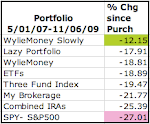
If you invested on May 1st, 2007, and you followed the conventional wisdom in fund investing these days which is to invest in index funds instead of managed funds, a year later, you might have have found yourself sitting on a loss instead of having made money.

And had you bought ETFs, generally the least expensive indexing option, your loss could have even more painful.

On May 1st 2007, I picked 20 mutual fund categories- ranging from Large Cap Growth to Inflation Protected Bonds to Emerging Markets. Then I hypothetically invested $2500 in funds I picked (available through Etrade with low initial investment minimums), Vanguard Funds (picking index options when available) and ETFs, in each of the 20 categories. I also invested in three Vanguard Index funds, matching the same percentage of Domestic equity, Foreign equity and Bonds as the other $50,000 portfolios.

I set up these hypothetical portfolios in the free portfolio tracking tool available at morningstar.com.

You can read more about this experiment here.

As of the close of trading on the last day of April, 2008, only the portfolio I picked avoided losing money. The WylieMoney Slowly portfolio has gained a hand picked fund in a new category each month and is also in the black. I have learned from my experiment and migrated many of my non-retirement investments into many of the funds I researched and my brokerage is also in positive territory.


If you had simply invested in the S&P 500, you would be sitting on a loss 0f -5.69%. Had you stuck $50,000 in a nice savings account, you would have beaten all of these portfolios.


The difference is not great, but I must admit that I am a little surprised that after a year, the funds I picked, outperformed all the index options. That the performance is the difference between making money and losing money is even more unexpected.

Here are the details (click on each image for a larger view):

WylieMoney 20 Mostly Managed

WylieMoney Slowly

My Brokerage

Three Fund Index

Lazy 20 Mostly Index

ETF 20

Combined IRAs

S&P 500


4.12.2008

Etrade Banking is Not Really Banking

"Etrade Banking is Not Really Banking"

What the heck does that mean?

I'm going to go out on a limb and make the claim that part of the banking experience is being able to access your cash. I opened an Etrade Checking account in December of last year. I have yet to be able to go to an ATM machine and withdraw cash from this account.

Last year I offered this advice to others who might try and change banks:

"Don't close your old bank until your new one is active and you have used it. If issues arise- your ATM PIN does not work for example, and you have already closed your old account, you will create undue stress for yourself."

Thankfully, I followed this advice, but I could not have known then that I picked an example I would actually face and how unbelievably bad the experience of opening a bank account with Etrade would be.

I did not get the $25 signup bonus as promised until I pestered them.

They did not send me an ATM card until I pestered them many many times.

How many times, you ask?


Sure, I could have hounded Etrade in February, but I was preoccupied with my emergency appendectomy.

So in mid March, I got my ATM and I got instructions concerning how to set the PIN. I called the number provided and set my PIN to be the same as my Citibank PIN so I would not have to remember 2 numbers. Today I went to an ATM, actually excited that I was all set and would finally be able to start using this account so I can close the other one and I got a message.

A little love message from Etrade:

"Invalid PIN"

So I pulled out my Citibank card and withdrew some cash.

Perhaps one could forgive Etrade for being unable to adequately support the banking services they are offering given the troubles they've had as a company.


But my other account is with Citibank who has shown you can dramatically run your company into the ground...


...and still provide basic banking functionality to your customers.

So far Etrade Banking has provided me with a place to park my savings that is better than the sweep account in my Etrade brokerage, but at this point, Etrade Bank's savings rates are no longer competitive.

You have to scroll wayyyyy down the list on Bank Deal's recent summary to find Etrade since there are still several banks offering over 4% and etrade is down to 3.10%.

So maybe I'll close this account and look for a better option. The bar has been set pretty low. I'll keep you posted.

I hope Donald Layton, Etrade's new CEO reads this. He has a long way to go to turn things around.

In January, I changed the mutual funds in my brokerage account to no longer automatically reinvest dividends and capital gains. At least I tried to. I noticed last week that one of my funds reinvested. Once again, I notified Etrade's customer service. They saw the error and are working to fix it... Those poor reps. They reply very quickly, but the business they are trying to support appears to be in chaos.

Donald, help me!!!!!

3.02.2008

Etrade and Taxes

Last year, Etrade had alerts all over its interface and sent me notices that I may receive updated tax info, after I received my original 1099 form. I was grateful since I knew to wait to file my taxes or risk needing to refile.

This year, there were no alerts and no messages.

I assumed Etrade had updated its business processes from last year to catch up with changing regulations and was prepared to get accurate tax information to me on time.

I even read blog posts that other brokerages were warning their customers that they may get amended 1099 statements. I was pleased that Etrade was more on the ball than these other brokerages.

Boy was I wrong.

Etrade backtracked big time. On Saturday, March 1st , I got an amended 1099. I got an amended tax form in March.

As I wrote before, I don't mind that with ridiculously complicated regulations, amended forms are necessary. I'm disappointed in my government that we have overly complicated regulations in how real estate investments are taxed, but vastly inadequate regulations in how those investments are made.

Anyway- Etrade could have put the same message up that it did last year but they did not. They could have emailed me as a customer with real estate investments and foriegn investments that I may receive an amended tax form but they did not.

The good news is that I have not filed my taxes yet and I was able to sign into my turbotax account and re-download my statement from Etrade and see the information and all the impacts automatically updated. What I owe in state taxes went up almost 100%. Fortunately the increase in my federal refund went up more than enough to cover the difference.

Shame on you Etrade for not communicating what you communicated last year. You even included a document with the amended statement with a form dated 1/08 called "Enclosed is your amended Consolidated Form 1099." If you knew in 1/08 that you needed a form for your customers, why not let us know?

Shame on me for assuming Etrade was on the ball.

Kudos to me (maybe my unconscious) for waiting to file my taxes even though I had already done them.

2.28.2008

Correction- JPMorgan Rate 1.69%

I wish I had taken a screenshot of the rate I was looking at when I wrote this post so I can see what I did wrong! I must have been posting much too hastily.

The JPMorgan Municipal Money Market Fund offered in Etrade's Brokerage account currently yields 1.69% This is less than 2.70% it was yielding in December, but much more than the 0.64% I posted yesterday. I did start that post a day or two before I published it but I can't imagine rates changed that much in two days.

My apologies!


Thanks to David for commenting and helping me realize I was wrong. To further clarify: the California Fund Yields 1.56%. This is equivalent to 2.65% if you pay the highest possible Federal and State taxes as a CA resident: "Based upon the highest combined federal and California individual income tax rate of 44.3%."

David asks how to keep up with the best account a bank is offering. First of all, when you do your taxes, calculate your actual tax rate. That will help you get a sense of how much more than 1.56% you are keeping by using a CA specific money market fund as a resident of CA.

Both the bank rate and money market rate have dropped as well as rate at most every bank out there, so the goal is not to find an that is not dropping (if that is your goal, CDs might help, but you'll miss out when rates go up if you are tied up in a CD). Banks (like Etrade) play games with their competition, keeping rates higher a little longer, trying to woo customers over, only to then drop the rate, maybe more than the competition.

If you really want to keep on top of the best bank offers out there, I recommend checking out the Bank Deals weekly summary. If you have an Etrade Brokerage then opening the Etrade Savings account may make sense so that you can keep your cash in either the Brokerage or the Savings account, whichever is better for you at the time based on rates and your taxes. I'm glad I opened the savings account since it can take a while to transfer money to and from the Brokerage account from a non-Etrade bank.

That said- don't close your old bank until your new one is doing everything your old one did.

I am still waiting on an ATM card for the Etrade Checking account I opened in December.

Let that serve as an example of the quality of service you might encounter using discount online services versus a local branch. So assess your tolerance for hassle before making too many changes.

2.12.2008

Yea Etrade Bank, Boo Etrade Brokerage

I recently posted about how Etrade failed to post my $25 sign up bonus in the timeframe they commited to.

After a gentle reminder to their customer service department, the $25 was promptly posted.


Still no ATM card, but I sent that request via snail mail so I don't expect to hear back for a while.

Then when Etrade does the right thing, another issue crops up.

A couple of days ago I tried to add a small amount to a mutual fund I own: PNRZX Jennison Natural Resources Z.

Etrade's interface listed the details- this is a no load fund with $0 minimum for additional investments meaning I can add $5 if I want- some funds require at least $100 or $1000, etc.

Then when I tried to buy, I got an error message. I had added a little to this fund in early January so I was surprised by the issue. I sent another note to Etrade's customer service inquiring about the error. They must be getting tired of me, but I don't make these issues up.

They responded:

"Thank you for your message regarding trading PNRZX. I apologize for any confusion. We no longer have a selling agreement with Jennison to sell the PNRZX fund. I have submitted a request to see if we can get another selling agreement but there is no guarantee that we are able to get an agreement. If you wish to sell the fund you can contact us by phone and we can place the trade for you. We can not allow you to purchase more shares through us until we have a selling agreement with the fund company."

Ok- so that is a bummer, but what irks me is they did not let me know. I own the fund, I add to it regularly. I have to find out by getting an error message and miss an investment opportunity? How hard is it to query out investors who own a fund when they lose the ability to buy or sell that fund through their interface and send us a heads up? How many other Etrade investors own this and are going to try and sell their holding and be thwarted?

Morningstar still lists that the fund is available through Etrade? See how Etrade is advertising itself on Morningstar's site above this false information?


I sent Morningstar an update that the fund is no longer available through Etrade. I'll let you know what they say.

You'll also note in the image above that the fund has an initial investment minimum of 10 million dollars. I put a little less than that (understatement) into the fund back in May 2006 (my initial investment is up almost 23%, the addition I made in Jan is down 5%).

I wonder if Jennision is trying to cut down on new cash coming into the fund, but does not want to close it to new investors for some reason. I also wonder if other fund companies are terminating buy agreements with Etrade and if this is a symptom of bigger issues? I really have no idea in either case, I just know if I want to sell the fund, I have to call Etrade and then try and avoid the fee they charge for phone orders...


Anyway, I understand that fund companies are going to do what they want, but I would have appreciated a notice about the change before I actually tried to add to my holding.

1.14.2008

Go Paperless with Etrade

This year I resolved to focus a little more on being less wasteful. Call it going green. Call it being more efficient. Call it whatever you want.

The bottom line is that everything you do impacts the world in which you live. You will never be aware of most of the impacts. Often the impacts are quite small, individually, and some are good. But many impacts are bad, even in small ways and waste is one thing that is pretty easy to be mindful of and often easy to do something about.

I am one of those kinds of people who actually thumbs through mutual fund prospectuses. Even money market account updates. I don't read them all the way through, but I glance through. So I have never considered it 'wasteful' to get them in the mail.

Truth is, since I have a laptop, it may be more convenient for me to have prospectuses sent to me via email so that I don't have to drag a bunch of paper with me until a good time to read them comes up. And even though I recycle them, it is still a lot of paper that has to be processed for no good reason.

So, I changed my preferences in my Etrade brokerage and IRA accounts. If you use Etrade, you can too and it is easy. I imagine for most brokerages with good online interfaces, it is pretty easy to do. For Etrade, here is exactly how you do it:

Log in.

In the "Accounts" tab, click the "My Info" subtab:

In the "My Info" area, choose the "Account Preferences: tab:


Scroll all the way down to "Account Features" and click the "Edit" link (not shown) next to the option "Electronic Documents:"

This will bring you to the "Go Paperless..." page. Click on the items you want to receive via email instead of in the mail and then click "Submit" (not shown). you can also change your email address here.


That's all there is to it.

I opted to still receive paper copies of account statements, trade confirmations, and tax documents as I file and save all of these. Read here to find out why.

12.30.2007

Opening a New Online Bank Account

I discovered bankdeals.blogspot.com a long time ago. Ken, the author, was one of the first sites to link to mine for which I was very grateful. More importantly, his site is a great resource for researching bank offers of all kinds, all around the country.

For a while I have been watching this site and keeping track of banks that offer much better rates than my own.

After reading chapter one on banking in Russell Bailyn's new book Navigating the Financial Blogosphere, I was inspired to take a look at how I park my cash and make some changes.

Many online savings accounts offer interest rates that are outperforming all the diversified mutual fund portfolios I have been tracking since May 1st. In reality, the top savings rates 5-5.50% are pretty close to the results of the mutual fund portfolios since the 5% rate is annual and most of the funds are up about 3%. YTD most of the Mutual fund portfolios have earned around 10%, but with a lot of volatility.

But your cash has to sit somewhere and 5% with no risk is not a bad place to park it. I mentioned above that my current bank's rates are not competitive. The truth is that I do not keep much cash there, so my motivation to change has not been great. Let's look at how I manage my cash, why, and the changes I am making.

I currently bank with Citibank. I have my paycheck deposited automatically into my checking account and I maintain a small balance in my savings account. I use yodlee.com to keep track of my bank, investment, retirement, mortgage, and credit card accounts. As paychecks come in and bills come due I pay my bills online and move any leftover cash from Citibank into my Etrade brokerage. I don't do this so I can invest the extra savings, but because cash in my Etrade account earns a tax free 2.70% APY compared to my Citibank Savings account which earns a taxable 1.76% APY.

My Citibank account has refunded all ATM fees (in the US anyway) for a long time, which is the main reason I have kept it. I have been able to use any ATM in the USA without worrying about fees. These days, many banks offer this service, so it is worth re-evaluting.

My Etrade brokerage account notes that 2.70% tax free is equivalent to a taxable 3.65% for those in the 35% tax bracket. I am not in that bracket, so my after tax rate is not that high. Since there are many banks offering over 5%, I do not need to worry about my exact after tax earnings. I will make more in a taxable account as long as it earns over 3.65% before taxes and finding a bank that pays that will be easy.

Two other things to note, especially as banks struggle and potentially go out of business. My Etrade Brokerage account is covered by federal insurance up to $500,000. Banks are covered
for up to $100,000 (though not all banks are covered so do your research). Again, I do not have enough money for this to factor in my decision, but if you have over $100,000 you are looking to park somewhere, think about how to spread it around to ensure that it is all covered, in case any given institution goes under. Second, if you are at risk of paying the Alternative Minimum Tax, taking a lower tax free rate may avoid even greater taxes by keeping your adjusted gross income low enough to avoid the AMT. If this is an issue for you, you may want to consult a professional.

Here are the top deals for savings accounts listed at bankdeals (12/28/07):


I am not interested in promo rates, though there is no guarantee any of these rates will stay where they are, especially if Ben Bernanke keeps lowering rates over at the Fed. I'm also not interested in a high minimum amount requirement. UFB Direct is interesting at 5.22%, but I am going with Etrade at 5.05% and here is why:

When I transfer funds from Citibank to my Etrade brokerage, the funds take a long time to become available in the Brokerage account. With an Etrade bank account I will be able to transfer funds between my brokerage, retirement and bank account with no delay. Etrade is giving me $25 to sign up (but this offer ends on the 31st so act fast if you want it). Also, there are incentives in both Etrades brokerage and bank account to maintain certain minimum balances for more benefits and to avoid account maintenance fees. If I moved the cash I have in my brokerage to UFB, I might lose some of those benefits or owe fees.

I also set up an Etrade MaxRate checking account which has a 4.0% APY. I will switch my direct deposit to this account once it is up and running and I have the ATM card and have given everything a test run. This means that even during the brief period my paycheck sits in my checking account before I pay my bills and transfer any savings, I will be earning a higher rate as well.

In summary I was using Citibank checking for ATM fee refunds and transferring savings into my brokerage earning a tax free 2.70% APY. I am switching to Etrade Max-Rate checking with unlimited ATM fee refunds, and 4.0% taxable APY and will transfer cash savings to Etrade Complete Savings earning 5.05% taxable APY.

Some tips:
  • Don't close your old bank until your new one is active and you have used it. If issues arise- your ATM PIN does not work for example, and you have already closed your old account, you will create undue stress for yourself.
  • Etrade Max-Rate checking has a fee unless you: 1) Maintain a minimum average balance of $5,000 in your Max-Rate Checking Account 2) Set up and maintain a direct deposit of $200 or more per month (A combination of direct deposits totaling $200 does not satisfy this requirement) 3) Maintain a combined balance of $50,000 or more in linked E*TRADE Securities, E*TRADE Bank, and employee stock plan accounts (including vested in-the-money options, stock option plan shares, ESPP shares, and released restricted stock) accounts 4) Execute at least 30 stock or options trades during a calendar quarter in a linked E*TRADE Securities account.

11.13.2007

Etrade, SIPC Coverage and Margin accounts

John left a comment pointing out that SIPC insurance does not necessarily cover everything in a brokerage account. He specifically mentions margin accounts, and links to this pdf. (Thanks John!)

I called Etrade this morning to close my margin account. I was on hold for 10 minutes and got through to a very friendly customer service rep who took care of this for me. I actually have no activity on margin so I don't think this mattered for me, but since I don't intend to use the margin account anytime soon, I closed it to keep things simple. If you do have and use a margin account (you should not have one by default- I set mine up years ago, but never used it), make sure you understand what is and is not covered by SIPC.

The pdf mentions:

"Excluded from coverage are: unregistered investments (i.e., limited partnerships), commodities, currencies and options. And remember, SIPC doesn’t protect against investor
mistakes."

If you have any questions or are at all uncertain about what is and is not covered by SIPC in the event your brokerage closes shop, even if you use a brokerage other than Etrade, WylieMoney strongly encourages you to follow up with a financial professional!

I, for one, hope Etrade pulls through. I have certainly had issues with them, but on the whole, their interface is great, the funds they offer are good, their costs are reasonable (as long as you meet the minimum balance requirements!).

11.12.2007

Is Etrade going to go out of Business?

Etrade is having trouble.

Will they go out of business?

Maybe.

Does it matter?

Well it would be a HUGE pain in my @#$@%!. But...

"E*Trade brokerage accounts are insured by the Securities Investor Protection Corporation, which can cover investors for up to $500,000 in cash and securities should a member broker go out of business, according to the SEC's Web site."

Also:

" Since the Federal Deposit Insurance Corp. guarantees bank accounts up to $100,000, customers with larger balances may move their money elsewhere, said Bhatia..."

What does all this mean? If you have more than $100,000 in cash at Etrade's bank or and/or more than $500,000 in cash and securities in an Etrade brokerage account, you should change that tomorrow. There is no point in risking your savings.

I don't have to worry, so I'm staying put. The hassle of having to deal with the SIPC if the brokerage unit collapses is less than having to try and document my transaction history.

I think a likely scenario is that another brokerage tries to buy Etrade, assuming they can end up with all the accounts without the bad debt... which would be a major bummer. Their site is very nice and the funds they offer are good.

I guess we'll see.

8.28.2007

Etrade fixed the problem again...

...but they still have not contacted me to let me know.

Basically, the minimum investment amounts for some mutual funds was not correct in their online interface.

More importantly, no one has explained to me what happened and why it happened. So I have no way of knowing if it is likely to happen again.

Perhaps they are too busy ending the program that reimbursed 12b-1 mutual fund fees.

Or maybe they are distracted by all the talk with Ameritrade about the possible "same-sector" marriage they are contemplating.

Regardless, I reported the issue in mid July and then again on August 7th. It was fixed around August 10th. But I have not heard it was or if I should expect that it will remain fixed. So I'll have to hope that next time I want to add to one of the funds I invested in, I will be able to...

8.20.2007

How Many Mutual Funds is Too Many?

Some folks over on Morningstar's discussion board tossed around the question:

"How Many Mutual Funds is Too Many?"

My answer is, "It depends."

“On what?” you might ask.

Well, a number of things.

Let's explore!

I have almost 60 funds. I can safely say, that is a ridiculous amount, but I don't mind. That brings me to point one.

1) If you don't mind how many you have, you don't have too many.

If you can't keep track of the funds, or feel overwhelmed when trying to manage your investments, you have too many. My tolerance for spending time keeping track of my funds is very likely higher than average, as evidenced by the fact that I write a blog about it. I do not recommend, doing what I do, to anyone else.

I find tools like Yodlee and Morningstar's free portfolio tool as well as the interface in each of the accounts I hold the funds in, makes it pretty manageable, for me. This brings me to my next point.

2) You need enough to achieve your goals for the money in each investment account.

My wife and I both work and we both have employer sponsored retirement plans and IRAs and we share a brokerage account. Our situation is not a-typical and that adds up to 5 accounts. Not all five are with the same brokerage and that means that funds available in some accounts are not available in others. Since the retirement accounts will remain invested until we retire and we are many years away from that, the funds best suited for very long term growth are not always the same as what we choose in our non-retirement account as we hope to use funds in that account before retirement (which is the reason we have it). Furthermore, we likely won’t tap the Roth IRAs at the same time as the 403(b)s depending on our tax situation at the time. Given all that, I choose to balance (Stock vs bond, Large Cap vs Small Cap, Domestic vs International, etc.) each of the five accounts as independent accounts. That way, as we access them at different times, I won’t have to re-balance one account because I drew down on another.

3) You need enough to attain diversity in fund companies.

I like to pick funds from different fund companies (Janus, Bridgeway, Artisan, T. Rowe Price, etc.) on top of picking funds that cover different categories (Large Cap Growth, Intermediate Term Bonds, Real Estate, Small Cap Foreign, etc.) A fund company might cover different categories, but they have one corporate culture and a pool of analysts who all work in the same environment, so there can be serious overlap in the companies that their analysts are recommending to their fund managers. Also, no one fund company has all the best managers in every category. When I picked the 20 funds for my hypothetical portfolio through Etrade, I ended up with a wide mix of fund companies without really trying.

4) You may end up with more than you need, depending on your employment history.

My employer used to allow me to use Janus for my 403(b) contributions so I had a portfolio of Janus funds. Then we switched to a company that picks top funds in each category regardless of fund company. I gladly signed up with the new, more diverse program, but I left my investments at Janus instead of rolling them over. Janus is strongly growth oriented overall and I liked having an investment at a pretty young age in a more aggressive portfolio than the new plan offers. This means I have 2 403(b)s with 8 funds at Janus and 12 in the other account. Our IRAs are held at Etrade and I cannot buy most of the funds available to me through my non-Janus 403(b) even if I wanted too. I do not want to add more in Janus funds for retirement so I am left looking for alternatives. Typically each year as I contribute to my IRA, I look for categories that I am not invested in that have been lagging, and then pick a good fund or ETF with a low minimum purchase amount (for funds) so I can diversify as much as possible. Having done this for several years and finding options that let you invest relatively small amounts, I have 14 funds in my IRA.

5) You need enough to diversify across sectors and/or categories.

You’ve heard the advice: “Invest in stocks and bonds.” And certainly you can buy a couple of index funds that broadly cover the stock and bond markets. Throw in a broad international index fund for good measure and you are pretty darn diversified with very little effort or upkeep. That approach may well be ‘enough’ to diversify across sectors. But if you want to invest systemically and try and follow a strategy of investing in categories that are down, presumably in the short term, you will need to pinpoint more specific categories or sectors. Real estate, small cap value, financial services, and precious metals have all struggled lately. To invest in these specifically you need to own funds that have these categories as their focus. How detailed you want to get will depend on your tolerance, your interest and your goals. The more detailed you get the more funds you probably need. For example, you probably would not want a portfolio of just the four sectors above unless you like to gamble.

6) You may not need any, if you have enough time and money to diversify in individual companies.

Mutual funds aren't for everyone. If I had enough money to invest in enough individual companies to feel adequately diverse (I kinda obsess over diversity so it would take a lot) and I had the time and expertise to stay on top of each company's performance and prospects, I might forgo funds and choose another path. Afterall, why pay fund managers year after year to do what you can do yourself!

7) If your time horizon is short, one may be too many.

If your time horizon is short, mutual funds or ETFs are probably not the best place for your savings. Note that portfolios of 20 funds spread across 20 sectors, 20 ETFs invested likewise and even the simple three index fund approach all lost money since May... with the 20 ETF portfolio down over 4%! Of course if you choose a money market fund, that might do well...

In summary, don’t invest in more funds than you can manage, but don’t avoid investing in a fund that interests you, if investing in it would help you meet your goals.

Recap- things to consider when trying to decide how many mutual funds is enough:
  1. If you don't mind how many you have, you don't have too many.
  2. You need enough to achieve your goals for the money in each investment account.
  3. You need enough to attain diversity in fund companies.
  4. You may end up with more than you need, depending on your employment history.
  5. You need enough to diversify across sectors and/or categories.
  6. You may not need any, if you have enough time and money to invest in individual companies.
  7. If your time horizon is short, one may be too many.

8.07.2007

Trying to get a response from Etrade... again.

Ever since Etrade became my brokerage, I have encountered problems with the allowable dollar amounts their interface permits.

Back in May, the minimum allowed amounts for subsequent investments through an AIP plan changed in Etrade's interface for two of the funds I own despite no changes at their respective Mutual Fund companies.

Then Etrade fixed the issue and I was pleased.

Then one day I logged in and it was broken again, for one of the funds.

So I called the local Branch in Boston many weeks ago and have heard nothing but crickets.

Today, I sent a request in through my account.

As always, I'll keep you posted. Below is the issue, as I reported it.

----
The mutual fund WFIVX has a minimum additional investment amount of $100. Your web site has the minimum set at $1000. You actually fixed this for me over a month ago but now it is broken again.

You can see right here where the fund company states that any additional contributions allow $100 minimum:

http://www.wilfunds.com/fees_minimums_dow_5000.html

You can see here where morningstar.com advertises that you offer this fund with an AIP allowing $100 contributions:

http://quicktake.morningstar.com/fundnet/Purchase.aspx?Country=USA&Symbol=WFIVX&fdtab=purchase

I have called the representative at the Boston Branch who coordinated this issue when you fixed it the first time over a month ago and have yet to hear back. I have tried to invest on two separate occasions but due to this bug, have been unable to execute my transactions.

You can read about this issue on my blog at http://wyliemoney.blogspot.com/

Please let me know if you have any questions.
----

7.29.2007

Etrade, what is wrong with you?

Not again!!!!!!

The great thing about No-Load No Transaction fee Mutual Funds is that you can invest in them over and over again without wasting money on fees. But this only works when you can invest the amounts advertised!!!!!


Here is the minimum in your web interface for your AIP:


Etrade, either you've got it wrong or Morningstar does.

And you fixed this just a month ago. So that's twice now that I've tried to invest and been unable to do so because of issues with your web site.

This is getting a little frustrating.

I called two weeks ago and left another message with the person who I talked to before, because I still have been unable to get someone to answer the phone directly at the Boston Branch. I have yet to hear back. I'll keep you posted.

7.10.2007

Additions to my hypothetical portfolios

Fed up with article after article saying buy this fund and that fund when no single brokerage actually lets you buy all funds, I chose a single brokerage (Etrade) and started researching funds in 20 different fund categories.

Curious whether this approach would lead to a portfolio of funds that could beat a similar portfolio of index funds, I identified the 20 Vanguard funds that most closely tracked the fund categories I had selected.

Also curious whether ETFs would be a better bet, I selected 20 ETFs, one for each category.

On May 1st, I invested $50,000 in each of the three portfolios by hypothetically 'purchasing' them, using the Morningstar.com portfolio tool as it allows me to reinvest dividends and capital gains distributions with minimal effort.

The funds I chose all allow minimum investments of $2500 or less. The Vanguard funds have higher initial investments, so you would not actually be able to buy the Vanguard portfolio unless you had more than $50,000 up front.

Also, the funds I choose all allow subsequent investments of $100 or less.

My goal here was to research a real world example of low cost options available through a
single brokerage that could serve as a model for someone with modest investment savings and a plan to invest over time.

Then by tracking the performance of such a portfolio against a couple of benchmarks, I hope to discover if this approach is worth the time and effort.

Finally, I also started tracking a portfolio of the 20 funds I selected, available through Etrade, buying one fund at a time to mimic how one could actually build this portfolio over time. I am adding the next fund, in the order I picked them, investing on the first day of each month that domestic markets are down significantly (leaving 'significantly' intentionally undefined).

Now I am going to add two new portfolios setting up additional $50,000 portfolios, invested on May 1st.

First, I am going to track the growth of SPY as a measure of the S&P 500.

Second, I am going to invest in total market indexes, in loose proportion to the 20 funds I have chosen: Vanguard Total Stock Mkt Idx VTSMX (55%), Vanguard Total Bond Market Index VBMFX (15%) and Vanguard Total Intl Stock Index VGTSX (30%).

If this 3 fund portfolio comes close to the 20 fund versions, then the answer is pretty clear as to what is the best (most efficient/worthwhile) way to invest in mutual funds, at least out of these options!

7.02.2007

Etrade fixes minimum investing in mutual fund issue

So before I left town for a while, I was trying to resolve an issue with my Etrade account. My man Justin got back to me and the issue was resolved, but I took a break from posting about financial matters while I was on the road. I did update the message in the upper right corner of this site to indicate that the issue was fixed though, so it would not look like Etrade was not following up!

Basically, the minimum additional purchases for two mutual funds I own were not allowing any additional investments under $1000 each. Morningstar listed the minimum additional investments for an automatic investment plan purchase as $100. When Justin called me up and left a message it should be fixed, I went into the 'Automatic Investment Setup' screen and could see the new $100 minimum amounts showing.

Now that July has rolled around, I will wait for the first down day on the market and try and add $100 each to these funds and see if it lets me.