Showing posts with label Brokerage. Show all posts

5.03.2008

Portfolio Update: One Year Results

If you invested on May 1st, 2007, and you followed the conventional wisdom in fund investing these days which is to invest in index funds instead of managed funds, a year later, you might have have found yourself sitting on a loss instead of having made money.

And had you bought ETFs, generally the least expensive indexing option, your loss could have even more painful.

On May 1st 2007, I picked 20 mutual fund categories- ranging from Large Cap Growth to Inflation Protected Bonds to Emerging Markets. Then I hypothetically invested $2500 in funds I picked (available through Etrade with low initial investment minimums), Vanguard Funds (picking index options when available) and ETFs, in each of the 20 categories. I also invested in three Vanguard Index funds, matching the same percentage of Domestic equity, Foreign equity and Bonds as the other $50,000 portfolios.

I set up these hypothetical portfolios in the free portfolio tracking tool available at morningstar.com.

You can read more about this experiment here.

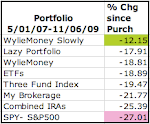
As of the close of trading on the last day of April, 2008, only the portfolio I picked avoided losing money. The WylieMoney Slowly portfolio has gained a hand picked fund in a new category each month and is also in the black. I have learned from my experiment and migrated many of my non-retirement investments into many of the funds I researched and my brokerage is also in positive territory.


If you had simply invested in the S&P 500, you would be sitting on a loss 0f -5.69%. Had you stuck $50,000 in a nice savings account, you would have beaten all of these portfolios.


The difference is not great, but I must admit that I am a little surprised that after a year, the funds I picked, outperformed all the index options. That the performance is the difference between making money and losing money is even more unexpected.

Here are the details (click on each image for a larger view):

WylieMoney 20 Mostly Managed

WylieMoney Slowly

My Brokerage

Three Fund Index

Lazy 20 Mostly Index

ETF 20

Combined IRAs

S&P 500


3.02.2008

Etrade and Taxes

Last year, Etrade had alerts all over its interface and sent me notices that I may receive updated tax info, after I received my original 1099 form. I was grateful since I knew to wait to file my taxes or risk needing to refile.

This year, there were no alerts and no messages.

I assumed Etrade had updated its business processes from last year to catch up with changing regulations and was prepared to get accurate tax information to me on time.

I even read blog posts that other brokerages were warning their customers that they may get amended 1099 statements. I was pleased that Etrade was more on the ball than these other brokerages.

Boy was I wrong.

Etrade backtracked big time. On Saturday, March 1st , I got an amended 1099. I got an amended tax form in March.

As I wrote before, I don't mind that with ridiculously complicated regulations, amended forms are necessary. I'm disappointed in my government that we have overly complicated regulations in how real estate investments are taxed, but vastly inadequate regulations in how those investments are made.

Anyway- Etrade could have put the same message up that it did last year but they did not. They could have emailed me as a customer with real estate investments and foriegn investments that I may receive an amended tax form but they did not.

The good news is that I have not filed my taxes yet and I was able to sign into my turbotax account and re-download my statement from Etrade and see the information and all the impacts automatically updated. What I owe in state taxes went up almost 100%. Fortunately the increase in my federal refund went up more than enough to cover the difference.

Shame on you Etrade for not communicating what you communicated last year. You even included a document with the amended statement with a form dated 1/08 called "Enclosed is your amended Consolidated Form 1099." If you knew in 1/08 that you needed a form for your customers, why not let us know?

Shame on me for assuming Etrade was on the ball.

Kudos to me (maybe my unconscious) for waiting to file my taxes even though I had already done them.

1.14.2008

Go Paperless with Etrade

This year I resolved to focus a little more on being less wasteful. Call it going green. Call it being more efficient. Call it whatever you want.

The bottom line is that everything you do impacts the world in which you live. You will never be aware of most of the impacts. Often the impacts are quite small, individually, and some are good. But many impacts are bad, even in small ways and waste is one thing that is pretty easy to be mindful of and often easy to do something about.

I am one of those kinds of people who actually thumbs through mutual fund prospectuses. Even money market account updates. I don't read them all the way through, but I glance through. So I have never considered it 'wasteful' to get them in the mail.

Truth is, since I have a laptop, it may be more convenient for me to have prospectuses sent to me via email so that I don't have to drag a bunch of paper with me until a good time to read them comes up. And even though I recycle them, it is still a lot of paper that has to be processed for no good reason.

So, I changed my preferences in my Etrade brokerage and IRA accounts. If you use Etrade, you can too and it is easy. I imagine for most brokerages with good online interfaces, it is pretty easy to do. For Etrade, here is exactly how you do it:

Log in.

In the "Accounts" tab, click the "My Info" subtab:

In the "My Info" area, choose the "Account Preferences: tab:


Scroll all the way down to "Account Features" and click the "Edit" link (not shown) next to the option "Electronic Documents:"

This will bring you to the "Go Paperless..." page. Click on the items you want to receive via email instead of in the mail and then click "Submit" (not shown). you can also change your email address here.


That's all there is to it.

I opted to still receive paper copies of account statements, trade confirmations, and tax documents as I file and save all of these. Read here to find out why.

1.08.2008

Reinvesting dividends and capital gains in a taxable account

Up until now, I had all my mutual fund dividends and capital gains distributions set to automatically reinvest in my taxable brokerage account.

This creates a bit of work when it comes to calculating the basis on my holdings when I sell a fund, but I don't mind. And with online brokerages, it is not much work at all. Etrade keeps track of the basis and I assume other brokerages do too. So as long as I note the basis before I sell and the holding no longer shows in my portfolio, and the records are accurate for holdings I bought before I started using Etrade, there is no work to do at all.

There are four reasons I turned off automatic dividend reinvesting, anyway:

1) If you sell a no-load no-fee fund within 90 days of purchase you are penalized a fee of $49.99. I do not know that this applies to automatic reinvestments (I assume it does), but I'd rather not worry or risk the hassle.

2) If I think I want to sell a fund, I typically don't add anything to it for a year before I sell so any gains are taxed as long term gains. I have two funds I have not been adding to since last June, thinking I might sell after my last addition to the funds is a year ago or greater. In December the funds distributed and reinvested automatically. This complicates the tax implications of a sale unless I now wait until next December which has slightly agitated my calm.

3) I invest regularly adding small amounts to some holdings to keep my overall portfolio balanced as I want it. Taking gains and distributions as cash and manually adding them to the funds I want to gives me more control over keeping my overall portfolio in balance. For some people (those who would let the cash sit) this might not be a good idea, but I have seen that I regularly take the cash I save in my brokerage and invest it, so this should work well for me.

4) Even though Etrade keeps good records of all my purchases, when Etrade bought my previous brokerage, the old electronic details did not convert over. I assume if Etrade goes under or another firm buys Etrade, or I end up with a new brokerage for any reason, the balances will transfer but the details about my basis will not. Sure I can keep track of everything myself, but to do so is more hassle than it is worth.

If you have an Etrade account that is not a retirement account, or even if it is a retirement account, and you want to un-enroll from automatic reinvesting, simply go to the online service center and type in a request to customer service for them to make the change. For mutual funds, you cannot do it yourself through their interface.

I left my Roth IRA alone so it still automatically reinvests. Since I only add to the IRA once a year, and I cannot add enough to rebalance all the holdings by adding to the market sectors that trailed the year before, and I don't have enough in the IRA for the dividends and distributions to be significant, and the IRA is not taxed like a non-retirement account, it make sense to me to allow the dividends to reinvest.

On an unrelated note, check out the Coyote I saw romping around in the snow in my driveway the other day!

11.12.2007

Is Etrade going to go out of Business?

Etrade is having trouble.

Will they go out of business?

Maybe.

Does it matter?

Well it would be a HUGE pain in my @#$@%!. But...

"E*Trade brokerage accounts are insured by the Securities Investor Protection Corporation, which can cover investors for up to $500,000 in cash and securities should a member broker go out of business, according to the SEC's Web site."

Also:

" Since the Federal Deposit Insurance Corp. guarantees bank accounts up to $100,000, customers with larger balances may move their money elsewhere, said Bhatia..."

What does all this mean? If you have more than $100,000 in cash at Etrade's bank or and/or more than $500,000 in cash and securities in an Etrade brokerage account, you should change that tomorrow. There is no point in risking your savings.

I don't have to worry, so I'm staying put. The hassle of having to deal with the SIPC if the brokerage unit collapses is less than having to try and document my transaction history.

I think a likely scenario is that another brokerage tries to buy Etrade, assuming they can end up with all the accounts without the bad debt... which would be a major bummer. Their site is very nice and the funds they offer are good.

I guess we'll see.

8.28.2007

Etrade fixed the problem again...

...but they still have not contacted me to let me know.

Basically, the minimum investment amounts for some mutual funds was not correct in their online interface.

More importantly, no one has explained to me what happened and why it happened. So I have no way of knowing if it is likely to happen again.

Perhaps they are too busy ending the program that reimbursed 12b-1 mutual fund fees.

Or maybe they are distracted by all the talk with Ameritrade about the possible "same-sector" marriage they are contemplating.

Regardless, I reported the issue in mid July and then again on August 7th. It was fixed around August 10th. But I have not heard it was or if I should expect that it will remain fixed. So I'll have to hope that next time I want to add to one of the funds I invested in, I will be able to...

8.07.2007

Trying to get a response from Etrade... again.

Ever since Etrade became my brokerage, I have encountered problems with the allowable dollar amounts their interface permits.

Back in May, the minimum allowed amounts for subsequent investments through an AIP plan changed in Etrade's interface for two of the funds I own despite no changes at their respective Mutual Fund companies.

Then Etrade fixed the issue and I was pleased.

Then one day I logged in and it was broken again, for one of the funds.

So I called the local Branch in Boston many weeks ago and have heard nothing but crickets.

Today, I sent a request in through my account.

As always, I'll keep you posted. Below is the issue, as I reported it.

----
The mutual fund WFIVX has a minimum additional investment amount of $100. Your web site has the minimum set at $1000. You actually fixed this for me over a month ago but now it is broken again.

You can see right here where the fund company states that any additional contributions allow $100 minimum:

http://www.wilfunds.com/fees_minimums_dow_5000.html

You can see here where morningstar.com advertises that you offer this fund with an AIP allowing $100 contributions:

http://quicktake.morningstar.com/fundnet/Purchase.aspx?Country=USA&Symbol=WFIVX&fdtab=purchase

I have called the representative at the Boston Branch who coordinated this issue when you fixed it the first time over a month ago and have yet to hear back. I have tried to invest on two separate occasions but due to this bug, have been unable to execute my transactions.

You can read about this issue on my blog at http://wyliemoney.blogspot.com/

Please let me know if you have any questions.
----

7.10.2007

Additions to my hypothetical portfolios

Fed up with article after article saying buy this fund and that fund when no single brokerage actually lets you buy all funds, I chose a single brokerage (Etrade) and started researching funds in 20 different fund categories.

Curious whether this approach would lead to a portfolio of funds that could beat a similar portfolio of index funds, I identified the 20 Vanguard funds that most closely tracked the fund categories I had selected.

Also curious whether ETFs would be a better bet, I selected 20 ETFs, one for each category.

On May 1st, I invested $50,000 in each of the three portfolios by hypothetically 'purchasing' them, using the Morningstar.com portfolio tool as it allows me to reinvest dividends and capital gains distributions with minimal effort.

The funds I chose all allow minimum investments of $2500 or less. The Vanguard funds have higher initial investments, so you would not actually be able to buy the Vanguard portfolio unless you had more than $50,000 up front.

Also, the funds I choose all allow subsequent investments of $100 or less.

My goal here was to research a real world example of low cost options available through a
single brokerage that could serve as a model for someone with modest investment savings and a plan to invest over time.

Then by tracking the performance of such a portfolio against a couple of benchmarks, I hope to discover if this approach is worth the time and effort.

Finally, I also started tracking a portfolio of the 20 funds I selected, available through Etrade, buying one fund at a time to mimic how one could actually build this portfolio over time. I am adding the next fund, in the order I picked them, investing on the first day of each month that domestic markets are down significantly (leaving 'significantly' intentionally undefined).

Now I am going to add two new portfolios setting up additional $50,000 portfolios, invested on May 1st.

First, I am going to track the growth of SPY as a measure of the S&P 500.

Second, I am going to invest in total market indexes, in loose proportion to the 20 funds I have chosen: Vanguard Total Stock Mkt Idx VTSMX (55%), Vanguard Total Bond Market Index VBMFX (15%) and Vanguard Total Intl Stock Index VGTSX (30%).

If this 3 fund portfolio comes close to the 20 fund versions, then the answer is pretty clear as to what is the best (most efficient/worthwhile) way to invest in mutual funds, at least out of these options!

6.06.2007

Ummm Etrade... anybody there?

I went in to Etrade's Boston branch with a customer service question on May 25th, 2007.

Mutual Funds allow different amounts for "Additional Minimum Investments" and "Additional AIP Minimum Investments." Morningstar.com lists these differences and lists Etrade as a provider for which these minimums apply.

I tried to set up an AIP for SSEMX through Etrade's website and was told the minimum I needed to invest in the AIP was $1000, not the $100 listed on Morningstar's site. I called Etrade and was told that as soon as I paid the additional $1000 on top of the $2500 I already invested when I first bought the fund, THEN I would be able to lower the AIP to $100.

I then did research and other funds I own did not charge me an additinonal "Initial AIP Minimum", if I already owned the fund so what I was told was not consistently true in the interface.

So like I said, I went to the Branch office on 5/25/07 and explained the issue to a representative who understood, agreed that the answer I got over the phone was not consistent with what we saw in the interface and forwarded the question to people people who would be able to figure out what is going on.

I have yet to get a follow up.

I called the Boston Branch phone number a couple of times but have yet to reach a person. Today I left a message. Then I called Etrade's main customer service line and got a customer service rep who looked up the extension of the person I spoke with at the downtown Boston branch and gave it to me and I called that number and left a message.

Please call me and let me know the answer to my question- Why can't I set up an AIP plan using my funds "Additional AIP Minimum" amount of $100?

FYI- the AIP page on Etrade's site says "Automatic investments require a minimum investment of $100 or the fund minimum, whichever is greater."

5.25.2007

Etrade, don't do this to me!

Arrrrggghhhh.

On this site I have put together a pretty detailed hypothetical portfolio available for purchase through Etrade. I have not gone into great detail about if I would actually buy these funds if I could or if I own any of them.

I do own some of them but I do not own all of them. Some of the categories I researched here, are categories for which I already own a Mutual Fund that I bought years ago. Even though the fund I picked for this hypothetical portfolio might look a little better than the fund I own, it is not worth it to me to sell my fund and pay the capital gains tax and then invest the leftover money in a new fund, at this point in time. Also I do not own funds for each of these 20 specific categories.

One of the funds I do own is SSGA Emerging Markets SSEMX. I bought it back in May of 2006. I have also managed to save enough to add $100 to my initial investment at a couple of points since then (not every month though!). Since I bought it, my holdings in this fund have increased 27.46%! Not bad for one year.

This is a risky fund and that risk has been well rewarded over the short term. I imagine it is only a matter of time before Putin does something so un-democratic that western investors balk and sell Gazprom in droves or China's speculators finally try and jump ship or Chavez convinces the rest of South America to 'reclaim' their private businesses. I do not know what it will be, but something will send emerging markets into a downturn.

In fact, yesterday, SSEMX was my second biggest loser down -2.03%. My biggest loser, if you're curious, was PNRZX. If you click that link, you'll see that PNRZX has been on fire over the last 5 years. I personally have only gained 10.30% since buying in just over a year ago. Not too bad, but not great given the recent gains I missed out on. My only fund that increased in value yesterday was BTTRX, a WylieMoney pick, up 0.14% on the day.

Even though I do not think it necessarily the best time to buy an emerging market fund specifically, I did try and add another $100 to my holding several days ago and was denied.

The entire reason I bought this specific fund and recommended each of the WylieMoney funds over sometimes better funds in each category is the $100 minimum for additional investments. I am still trying to figure out what happened here, but the last time I added $100 to this fund was in February. Now the minimum that Etrade is letting me add to my holding is $1000. So something changed in the last few months. Despite trying to save and invest as much as I can, I cannot afford to add $1000. And I should not have to darn it! Here is what Morningstar claims the fund allows:


What I suspect happened was that SSEMX changed its 'Additional Minimum Investment' to $1000 recently. You can see above it is $1000 now- I do not remember if it was that way before February. Fine. Gone are the days I can add $100 whenever I have the $100 to add and think the timing is right. I am willing to set up the Automatic Investment Plan or AIP for this. The Additional AIP minimum is listed as $100.

Etrade allows you to set up an AIP that invests in a few different intervals:


If I can come up with $400 a year to add to this fund, I could choose the "Quarterly" option and be all set, right? Not so fast! Here is a picture of the option I get when trying to set up the additional AIP investments:


So I called Etrade and here is what they tell me. Despite the fact that I already paid at least an initial $1000 when I first invested, to set up an AIP now, I have to pay another $1000 before I can reduce the AIP investments to $100. Since you can start and stop an AIP at anytime, this leaves me wondering if I should not have just bought the fund through this screen and set it up with an AIP plan for once a year that I never intended to make on that schedule and then just adjusted the frequency and amounts as desired.

But this does not make sense. I should not have to pay different amounts based on which screen I used to buy the fund. Does this make sense to anyone else? Do all brokerages and funds that have different minimums for AIPs and and non-AIP subsequent purchases make you pay a separate 'Initial Investment Amount' to both buy the fund initially and then set up the AIP as well?

This is not what is going on at Etrade either, at least not consistently. Another WylieMoney recommended fund I own is American Beacon Large Cap Value Planahead AAGPX. Here are the details for this fund from Morningstar:


So to set up an AIP to automatically invest $50, I should have to first pay another $2500. But I don't. Here is my option in the drop down menu:


I'm going to try approaching Etrade again and see if I can find out more.

5.21.2007

If you want to sign up for Etrade, I've got a deal for you!

I know of at least two WylieMoney readers who have signed up for Etrade. I just got an offer as a current Etrade user- If I refer a new user I get $50 plus the new user gets up to 100 commission free stock trades to use within the first 30 days of opening an account. The offer lasts through June 30 and does not count toward IRA or other retirement accounts. So if you are thinking about signing up, let me know and I'll shoot you the details of the deal I have.

I don't know any folks who are gonna benefit from being able to buy or sell 100 different stocks in a month, but hey, you never know. And if you did want an account and wanted to buy some GE and AAPL stock right off the bat, well this deal would save you about $20 and give me $50.

Don't pick Etrade just for this. Pick a brokerage that best addresses your needs. I was chatting with a couple who recently decided to open a brokerage account and one of their needs was a direct connection to a person they could establish a relationship with to work with at the brokerage to help them through the process of opening and managing their account. Etrade does not meet this need and was clearly not the right choice for them! I'm sure Etrade would disagree and probably offers this kind of support for a fee, but finding a financial planner or analyst you trust is an entirely different matter. This couple has such a planner already so Etrade did not make sense.

I have shared some of my thoughts about Etrade before. The tools Etrade offers are simple and fairly sophisticated. They have been expanding functionality since I joined which is great. Calling customer service, however, is rarely an encouraging experience. It has taken me many months to resolve past issues. I imagine their service reps are good at explaining how to use the site. But when the site is not working like they think it should be, they are not good at finding out why. I will soon be writing a post about a new problem I am having with Etrade. Their interpretation of individual Mutual Fund policies does not consistently match how their tool interacts with those policies. More about that soon.

So, after this hard sell (hehehe), if you want to open an Etrade account, please email me at wyliemoney at gmail dot com. But do not open an account if you do not plan to maintain a $10,000 balance after the first year as Etrade will sock you with inordinate quarterly fees.

3.24.2007

What investment records should you keep?

Keep them all.

Lots of financial sites and blogs post articles offering advice about what records to keep in general: bankrate, soundmoneytips, realsimple, even the IRS has made an attempt.

As is often the case, Morningstar has one of the best explanations for why this matters when it comes to investment records.

I keep every monthly statement from my brokerage and have a file over 2 1/2 inches deep to show for it. I wish this was an indicator of massive wealth, but really it is just a symptom of reinvested dividends.


If you put $500 in a growth and income fund and reinvest the dividends and capital gains, each payment- in cents, dollars, whatever, is a transaction on the statement. And at the end of the year, you pay income taxes on those payments, even though they are (re)invested, and not cash in your pocketses. So if you do not have a ton of money (yet!), but still want to diversify broadly and put a small amount of money in a number of funds instead of just piling it all into one, your statements get long.

Some of the new retirement funds like Vanguard Target Retirement 2050 are actually a collection of funds, so you can put all or some of your money in one of these, even if you do not plan to save it until retirement, and diversify that way, but I digress

Some brokerages are no longer sending paper statements automatically and actually charging investors for this 'privilege.' Here is Ameritrade, disclosing its fees:

So if you only get electronic statements, or opt to get electronic only, you have to keep those too. And back them up!

I finally got my 3rd and 4th brokerage account tax statements. One of these adjustments changed how $22.46 was allocated for tax purposes. I waited a month and a half to file my taxes because of how $22... good grief.

So anyway, I sold a fund last year and I knew how much I originally invested, and Etrade does a good job of keeping track of funds that have automatically reinvested since they bought my account from my previous brokerage. My old records, however, did not convert to my Etrade account so I had to go back through my paper records starting in 2000 when I bought the fund to calculate my actual basis. This took me about 3 minutes to do because I had all my records in order and this changed my basis by a couple of hundred dollars which lowered my tax bill enough to buy a decent bottle of wine! Or, if I shop at Trader Joe's, 3 or 4 decent bottles of wine!

So the lesson here is that you should keep your statements, paper or electronic, because your brokerage may be bought by a competing brokerage, or it may raise its fees and you may transfer your account to a better brokerage and all your details may not transfer over. And unless you want to pay the tax man (or woman) for the same profits twice, you'll want to be able to add up your actual basis, not just the amount you originally invested and having your statements handy and organized makes this pretty easy.

2.25.2007

Misleading article about building a 'lazy' portfolio.

Paul Farrell wrote an article the tone of which is "even a second grader can invest in a simple portfolio and beat the market." As I started to read through this, I saw several things that bugged me so I decided to explore in greater detail.

The first thing that stands out is that to set up this portfolio you need a parent who has enough invested at Vanguard to waive the minimum requirements for each fund. So not any second grader could do this but second graders with parents who have some unspecified amount of wealth invested at Vanguard can do this.

Let's assume that not everybody has parents with huge investments at Vanguard but is looking for a way to begin investing. Does this approach still make sense? From what I can tell after poking around on Vanguard's site, this simple portfolio would be assessed a $30 annual fee until little Kevin's account was worth at least a quarter of a million dollars. In addition to that, each individual fund has another annual $10 fee until each holding is worth $10000.

So this lazy portfolio would cost $60 per year in fees. Now $60 is only a very small percentage of $9000 and these funds have very low expenses assessed within the funds themselves, but these fees make me mad anyway and should at least be mentioned.

Then, what really caught my eye was this chart which is terribly deceptive:

The $3000 minimums listed do not represent the allocations used to calculate the actual returns. There is a column called "Allocation" that clarifies the actual allocation used to calculate the returns, but these allocations are not allowed in Vanguard funds to for the typical investor with this much to invest. So for those of us whose parents don't have their nest eggs socked away at Vanguard, this portfolio, with equal $3000 amounts invested in each fund, would have under performed the S&P 500 over a 1 year period, not out-performed it as listed. And the performance above the S&P over the 5 and 10 year periods would not have been as great and none of these returns factor in the $60 in annual fees. Again these fees are not huge but over 10 years they total $600. 1, 5, and 10 year annualized returns with equal weight in the 3 funds would have been: 15.45% 9.38% 7.44% -not shabby, but not what is listed.

I do not want to be too critical of Mr. Farrell because I appreciate his approach in general: to advocate simple, diversified low cost portfolios that take very little management. But part of why I started my project was because none of the pundits writing about various methods for building portfolios actually ground their recommendations in the real world with portfolios you can really build with little money to start and with clarity about the fees.

What I am doing on my blog is using Etrade to propose a portfolio that you can actually buy, with $2500 minimums and no fee $100 monthly additions. Etrade has a $10,000 account minimum or an absurd $40 per quarter fee. So my hypothetical picks would not be good for someone with only $9,000 either. But if you have the $10,000 total, there is no individual fund fee or account fee in addition to this if you are using Etrade. The first four funds I recommend with $2500 minimums in each would total $10,000 but you should be sure and add a little more than this to avoid Etrade's absurd $160 annual fee in case these funds lose value in the short term.

I've written before about my issues with coming up with accurate statistics- indeed the chart above does not clarify if dividends are reinvested or not to achieve these averages. But I am going to show you the results of my picks according to the same source Mr. Farrell uses so you can compare:

The lazy portfolio beat my hypothetical portfolio over the past year, but my portfolio come out ahead over 3 and 5 year periods. The Mid Cap Growth fund I recommended has not been around for 10 years so I cannot compare a total 10 year performance, but the other three funds I recommend have all outperformed every one of the Vanguard funds over 10 years.

My point in all of this is that it would be nice if people talking about how simple it is to invest would be clear about fees and minimums and use actual, possible scenarios that anyone can follow (at their own risk of course!).

1.29.2007

Picking a Brokerage

I know a number of folks in the process of rolling old 401(k)s into IRAs or setting up brokerages for the first time. I have discussed the pros and cons of a few brokerages with a few folks, but the truth is, it is hard to compare because the offerings, fee structure, and resources available are very different from firm to firm and there is not a good website that I can find that really compares it all. That said, smartmoney.com has done a nice job of categorizing several brokerages and rating them. They do not explain every feature so you should do more research- but this is a good list of brokerages and summaries of who they might best serve.

I use etrade, because my original brokerage was bought by another brokerage that merged with another that was bought by etrade. This process has not been fun- especially given that my historical records have not been carried over from company to company.

Despite the fact that my experiences with etrade have mirrored those described in the article, I am not surprised that they rated etrade #2 under their premium brokerage category. I got a kick out of (but do not completely agree with) their summary concerning many of the etrade critics that- "...much of (their/our) griping may stem from resistance to change."

Given a plan like my hypothetical non-retirement portfolio of mutual funds that allow $100 monthly or quarterly contributions for NO fee- etrade seems like the best bet.

The bottom line is that when choosing a brokerage- you need to figure out what you want to do with it and how much help you will need doing it. If you are going to roll-over an IRA and invest it in a couple of funds and forget about it until you retire, you do not need a brokerage that offers a ton- just one with the lowest fees possible. If you want to invest actively and do not need help from your brokerage and are ok with really poor customer service, etrade may be your best bet. Smartmoney also mentions: "
Lilien, the firm's president, says E*Trade plans to spend an extra $42 million on customer service this year."

Motleyfool has another resource to help you pick a brokerage- I like the comparisons it makes and the info it looks at but it only reviews 4 companies.

1.26.2007

Wait to file your taxes if...

...you own a brokerage account.

I was jealous of a colleague who declared that he already had his tax refund on the way. I was even more jealous of the fact that his refund was small.

Why would I be jealous of a small refund?

In this case the government has been taking only as much money from my colleague over the course of the year as he ultimately would owe in taxes. Some people like getting big refunds, but that is a big interest free loan you are giving to the government... If you have enough income to do that, I've got a bridge for sale...

So if you can only have what you will owe withheld (takes good planning), you get paid more throughout the year meaning you have more every two weeks to donate to charity, spend on bird seed, or spend at the movies.

Anyway- last year I got an amended tax statement from my brokerage and I was really glad I had not submitted my taxes, because I would have had to re-submit them with the new form if I had been more on the ball. This year, I have yet to receive my tax statement from etrade and when my colleague was like "I'm done with my taxes" I was all like- "what is up with my stuff?"

So I logged into my etrade account and found this buried in the page that allows you to view your tax forms:

"If you hold a mutual fund, REIT, or RIC, we may need to issue you an amended Form 1099. This may affect the date you will want to file your tax return. To minimize the possibility of multiple corrections, we will not be generating amended 1099s until late February 2007."

I didn't even know what a RIC was but I own Mutual Funds and a REIT (Boston Properties).

My initial reaction was- why can't etrade get this stuff right the first time? Then I read an article by Andrea Coombes that led me to believe that brokerages are required (perhaps by law?) to send tax info by Jan 31st, but that many mutual funds and REITS send updated info to brokerages after this date forcing brokerages to send multiple copies and forcing those of us who invest in Funds and REITs to wait to file our taxes or file multiple times. Andrea specifically notes that some Brokerages are seeking permission to wait to send their tax info to clients.

Since etrade bought my old brokerage, but the transfer did not happen until a couple of weeks into Jan. I wonder how may tax forms I will actually get...

etrade does have this message on my account home page:

"1099s Available by January 31st.
This year as part of your move to E*TRADE Financial, you may receive TWO tax statements for 2006. Your tax statement(s) will be mailed to you and made available online by January 31."

What this should say is that I may receive FOUR tax statements and should not even bother trying to figure out my taxes until the end of Feb.

But regardless, the confusion and how long it is taking for me to receive this info does not appear to be etrade's fault, but rather a result of changing and complicated regulations.

1.23.2007

etrade updates its mutual fund screener

I have written about etrade and explained that I am using it to pick mutual funds for my hypothetical non-retirement portfolio. I have warned folks picking a brokerage to be wary of fees at any brokerage and decide how you want to use your brokerage account before opening a new account with any company.

I use etrade for my IRA and non-retirement savings and that is why I have access to their mutual fund screener which I have talked a little bit about.

So today, when I signed in to make my next pick, a Large Cap Value fund, I was surprised to see that they have upgraded their fund screener.

The old screener was more or less like what you can find on any financial news web site. But the new features will make it much easier to do what I have been doing: pick no-load funds by sector specifically looking for good non-retirement investments.

Some obvious improvements include being able to exclude closed funds and exclude funds that require huge amounts for initial investments. Even better, as I add criteria, I get a running tally of how many funds are available based on my choices so if I am too restrictive and only a few funds will show when I pull up the details, I can expand my search. The last major improvement is that I can save my criteria- so as I start each new search, all I have to change is the category I am looking at.

So... Specifically I am screening out funds that:
  • are available through etrade
  • are no-load, no-fee funds
  • are available to new investors
  • have 3-5 stars from morningstar (some index funds end up with 3 stars)
  • have below $5000 initial investment (I wish it let me set this at $2500 because that is my actual cut-off for this project
  • have an expense ratio below 1.5 (different categories have different averages on this and turnover so this will be a setting I tweak)
  • have a low turnover
Here is what the fund screener looks like:


I am poking around a bit and it looks like they have replaced the Standard and Poors report they used to link to each fund with an in-house etrade report. The new report and new detail screens look nice and are easier to navigate through. The one piece missing is the style composition box- which I actually used a good bit. I'll email etrade and ask about it which will also give me a chance to see, anecdotally, if their customer service has improved at all.

11.14.2006

Etrade: Mutual fund offerings

I would avoid using a brokerage that only offers funds of one company. Putnam, Janus, Fidelity etc. To better diversify, it is important to pick funds from different companies as well as from different sectors. Even though funds at one company may have different managers and focus on different market sectors, sometimes they use the same pool of analysts so funds covering ‘different’ market sectors may end up holding the same companies resulting in a less diverse portfolio. Besides, I am not aware of one fund company that covers all the sectors I want to cover and also beats the averages of funds covering those sectors, in every case. If any of you know about one, let me know!

As mentioned before, I will use Etrade for this hypothetical portfolio, but other brokerage may offer the tools to set up a similar plan. Motley Fool's website has a comparison of a few brokerages and Dogs of the Dow's site offers more information including customer feedback.

Etrade offers funds from many families and most critical to the wealth building scheme I propose to develop, it offers many no-load funds available for purchase for no fee (It advertises over 1000 of these). One family of funds I like to keep an eye on that is not well represented at Etrade currently is Artisan.

A search for no-load, no-fee funds finds 1158, but some of these are closed to new investors and some have minimum initial investments of $1 million or more, so the actual number of open no-load no-fee funds with minimum investment amounts of say $5000 or less is not clear. It would be nice if the fund screener tool let you exclude funds with high minimum investments or that are closed to new investors, but it does not.

11.10.2006

Etrade: Fees

The info on this post is from 11/10/06 and will change so do your own research if you are interested in finding out more, whenever you are ready. Also, these are the fees that will or could impact a plan like the one I am proposing, not a complete list of fees.

Minimum Balance Fee:
$40 quarterly Low Balance Fee -if the balance in your E*TRADE Securities account is over $10,000 or the total combined balance in your linked E*TRADE Securities and E*TRADE Bank accounts is over $20,000 you do not have to pay this. Also, these fees are not charged for accounts in the first year (this is a nasty policy) .

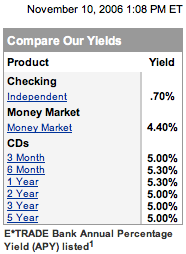
You should not set up a non-retirement brokerage account with Etrade unless you have more than $10,000 that will remain there until the account is closed as paying $160 annually in maintenance fees is ridiculous and you can easily find a different brokerage that does not charge this. Also, I do not recommend opening an Etrade bank account. All their adds suggest a savings rate of 4.4% which is not great but not bad especially compared to what many local branches offer.


When you dig around, however, you will find that if your balance is under $5000, the current rate is .30%.


You can find an online bank account with better rates without balance restrictions. Bank Deals is an excellent site for tracking down online banks.

11.08.2006

Brokerage Accounts: Thoughts about Etrade

I have an Etrade account and will limit my choices to funds available through Etrade, as long as I continue to use Etrade. Let me start by saying that I did not choose Etrade, but I am satisfied with it. I opened a Discover brokerage account which became a Morgan Stanley account which became a HarrisDirect account which then became an Etrade account. The things I keep an eye on are Fees, Mutual Fund offerings, Services and Tools, and Yields on cash held in the account. This can be a bit tedious since brokerages merge, get bought, and change fees and services constantly (see above), but unlike what the market does, you can control what fees you pay and what services you use by keeping abreast of what the competition is offering and change your brokerage if necessary. If you think about brokerages in this light, one of the most important things to identify before setting up an account is the “Account closing fee.”

Another point- The internet is overflowing with Etrade customer service complaints. I too have had difficult and tedious customer service experiences with Etrade, though like many- I was persistent and ultimately reached someone who helped me more than I thought they would. That said- I would be interested in hearing if other full service brokerages offer a broad range of no-load no-fee mutual funds and if other brokerages have better customer service. Such funds are also referred to as NTF (No Transaction Fee) Funds.

Before I start picking funds, I will look at Fees, Mutual Fund offerings, Services and Tools, and Yields on cash held in the account.